

Washington Weighs a Label, Not a Ban, for Chinese AI
The Trump administration is considering a plan that would make US companies say on their websites when their products use Chinese AI models such as Qwen, DeepSeek or Kimi. It is only a proposal, and no draft has been published.
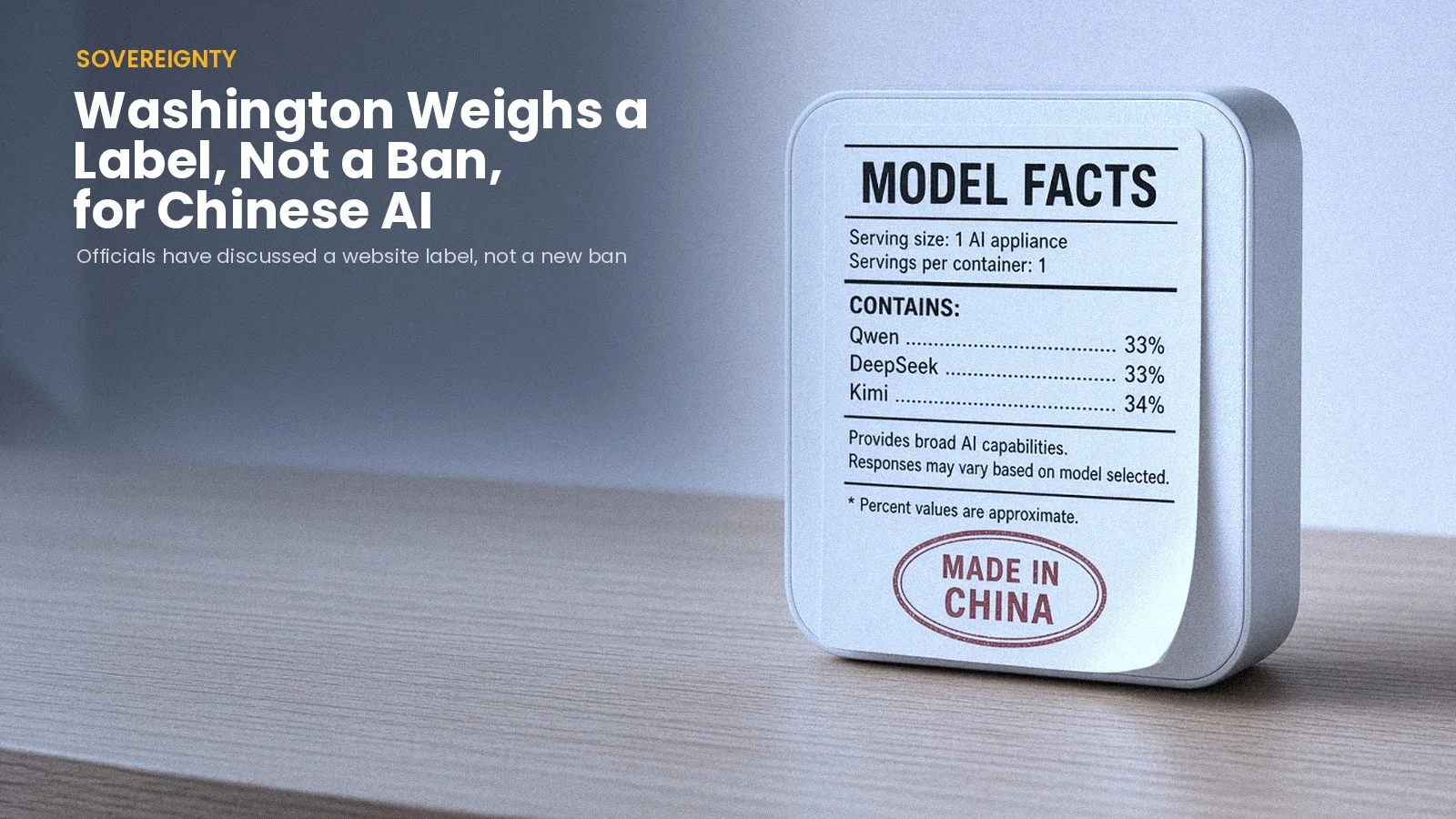
The Trump administration is considering a requirement that would make US companies say on their websites when their products use Chinese AI models. Officials at the Treasury Department and the White House Office of Science and Technology Policy have discussed the idea, three people told Reuters, which first reported the talks on 18 November. The aim is to discourage that use without a new ban, which could anger industry or Beijing. No draft has been published. Reuters said it was not clear whether the idea had wider support inside the administration, or whether it would go through formal rulemaking. The White House and the Treasury Department did not comment. The Chinese Embassy in Washington told Reuters that Beijing opposes politicizing trade and technology issues.
A label, not a ban
The plan would cover Chinese open-weight models such as Alibaba's Qwen, DeepSeek, and Moonshot AI's Kimi. Open-weight models make their core components public, so a company can download them, adapt them, and run them. Reuters said these models have gained ground with US firms because they cost less than tools from OpenAI and Anthropic, and work well enough for many jobs. In October, it said, Chinese models were the three most used by token volume on OpenRouter, an AI marketplace.
Airbnb uses Qwen to power its customer service agent. In a statement to Reuters, the company said its AI work "runs overwhelmingly on U.S.-origin models," and that the China-origin models it does use are open-source and run only through approved US-based providers. That is the company's account. An April letter from two House committee chairmen said Airbnb had publicly described Qwen as "fast and cheap."
Congress is already naming companies
The letters came from House Homeland Security Chairman Andrew Garbarino and John Moolenaar, who chairs the House select committee on China. They opened a joint investigation in April, writing to Airbnb about Qwen and to Anysphere, the maker of the coding tool Cursor, about Composer 2. Reuters reported that Composer 2 was built on a version of Kimi. The April letter says Anysphere confirmed that origin after an independent developer found it. In July the chairmen wrote to DoorDash, after co-founder Andy Fang said an internal code-review system sent lower-level work to Kimi K2.6. Moolenaar told Reuters that disclosure is "an important step in managing the potential risks posed by the diffusion of Chinese open-weight models in the United States," and that risks remain even when companies run the models on their own systems.
The idea fits a pattern PSI Daily noted in September, when a House bill sought to score foreign open-weight models without banning them. This week's plan would go further, by putting the label on each company's own website. If it became a requirement, model origin would work like a supply-chain label, and every buyer would have to check where a system comes from. For now, it is only a proposal.
Sources
- Exclusive: Trump administration weighs forcing US firms to disclose Chinese AI use (Alexandra Alper, Reuters, 18 November 2026)
- Chairmen Garbarino, Moolenaar Announce Joint Investigation into National Security Risks Posed by PRC AI Models (House Committee on Homeland Security, 29 April 2026)
- Letter to Airbnb CEO Brian Chesky (Garbarino and Moolenaar, 29 April 2026)
- Letter to Anysphere CEO Michael Truell (Garbarino and Moolenaar, 29 April 2026)
- Chairmen Garbarino, Moolenaar Continue Joint Investigation Into Security Risks Posed by PRC Open-Weight AI Models (House Committee on Homeland Security, 31 July 2026)
- Letter to DoorDash CEO Tony Xu (Garbarino and Moolenaar, 31 July 2026)
- House Bill Would Score Chinese Open-Weight AI, Not Ban It (PSI Daily, 3 September 2026)
Illustration: AI-generated for PSI.