

Microsoft Adds Sovereign Cloud Tools, Not Legal Independence
At Microsoft Ignite, a sovereign control panel entered public preview and local AI and coding tools went on general release. Microsoft says a European partner will oversee engineer access in the EU. The legal question remains.
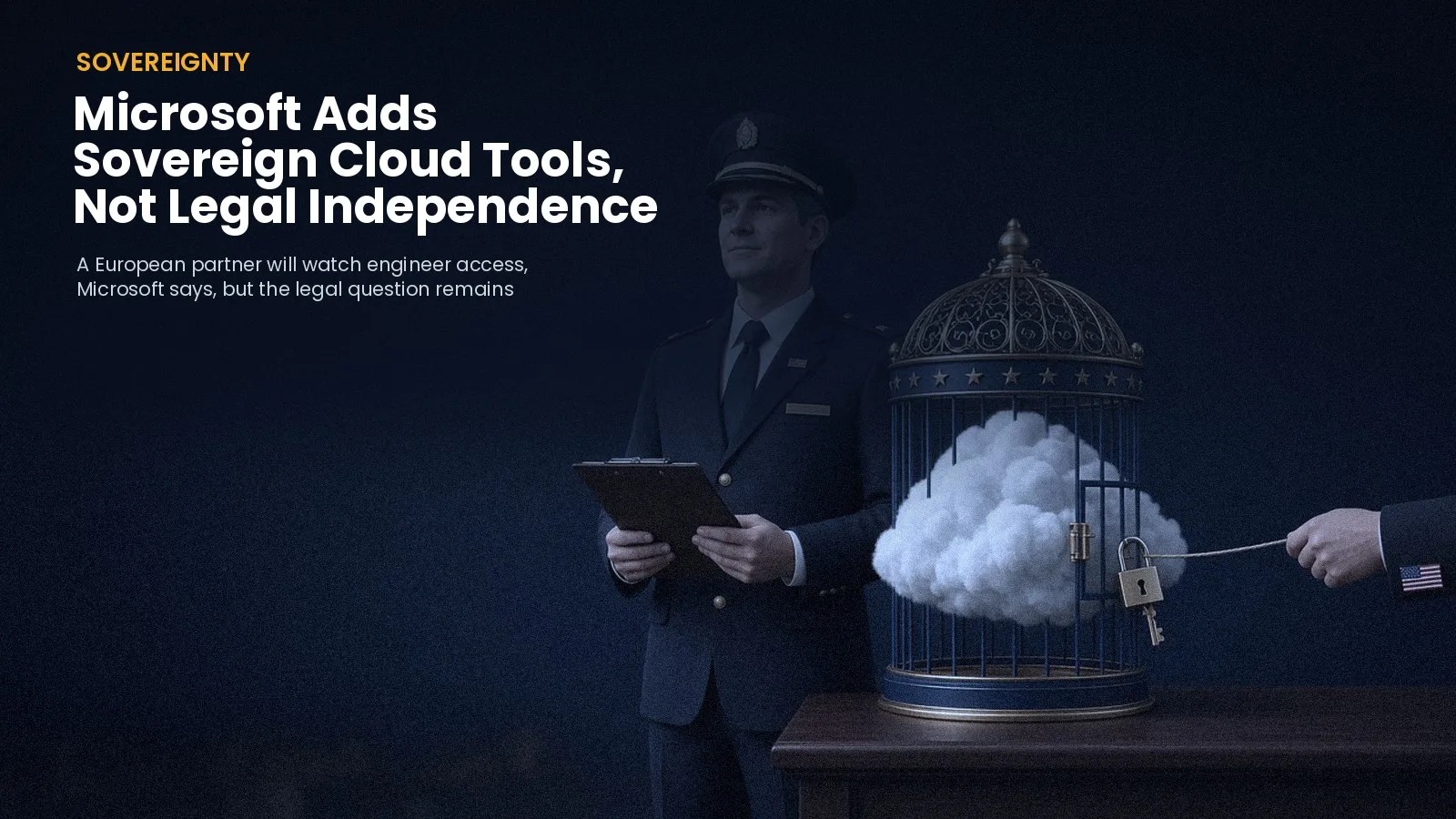
At Microsoft Ignite in San Francisco, which opened on 17 November, Microsoft is showing new tools it says give customers more control over their cloud and AI systems. A Sovereign Control Panel is now in public preview. For clients in the EU and the European Free Trade Association, Microsoft says staff from a trusted European partner, based in Europe, will watch when its engineers remotely access covered production systems, and that those sessions will be logged. Local versions of its AI platform and of GitHub are now on general release, the company says. Microsoft first set out this package on 20 October. The releases come days after a nearly 24-hour Microsoft outage that PSI Daily covered on 15 November. The tools add operational controls. They do not settle whether a US company can still be compelled to hand over European data.
What Microsoft is putting in customers' hands
The control panel, Microsoft says, lets organisations see whether their Azure systems meet rules on where data sits, how it is encrypted, and whether work can keep running if something fails. Microsoft's own documentation says the preview is aimed at European cloud regions, hosted in Sweden, and that the checks do not themselves enforce the rules.
Data Guardian is part of the same package. Microsoft announced it in June 2025 and said in October that it is rolling it out in the EU and EFTA, but only for qualifying remote access to covered systems. A related tool, Production Touch Ledger, is meant to record that access and the actions taken, in a form that would show later tampering.
Microsoft also said Foundry Local is now generally available on Azure Local, the version of its cloud that runs in a customer's own data centre. It lets customers run AI models on their own machines, including when they are disconnected from Microsoft's cloud. GitHub Enterprise Local is also on general release, the company says, as a ready-made copy of GitHub Enterprise Server that keeps code on the customer's systems.
What this does not settle
These are Microsoft's claims, and they have not been independently tested. The legal question is also still open. The US CLOUD Act can require a US provider to hand over data in its possession, custody or control, even when that data sits outside the United States. CIO quoted analyst Pareekh Jain, in coverage of the October announcement, as saying Microsoft remains subject to US laws, and that customers gain more operational independence but not complete legal or technological independence. Heise reported that the German Informatics Society warns the CLOUD Act can still pose legal risks even when data is processed in Europe. Last year, Anton Carniaux of Microsoft France told a French Senate inquiry he could not guarantee that data would not be handed to US authorities without French consent, though he said it had never happened. Microsoft has not said the new tools change that legal position.
Sources
- Advancing digital sovereignty with greater control and choice (Microsoft, 20 October 2026)
- Sovereignty at Microsoft Ignite (Microsoft, 16 November 2026)
- What's new with Sovereign Private Cloud at Microsoft Ignite 2026 (Microsoft, 17 November 2026)
- Sovereign Control Panel (preview) overview (Microsoft Learn)
- Data Guardian overview (Microsoft Learn)
- Microsoft adds EU access oversight and offline AI to its sovereign cloud (The Next Web, 20 October 2026)
- Microsoft expands sovereign cloud offerings as data control concerns grow (CIO, 21 October 2026)
- Microsoft promises greater cloud sovereignty for businesses (Heise, 21 October 2026)
- Microsoft exec admits it 'cannot guarantee' data sovereignty (The Register, 25 July 2025)
- Microsoft Sovereign Cloud: keys on own hardware (ITdaily, 20 October 2026)
Illustration: AI-generated for PSI.