
Two Chinese AI labs shipped near-identical models a day apart
Z.ai and Alibaba released open models a day apart in late August, and the two designs turned out to match on four separate choices. The reason says something about how fast Chinese labs are borrowing from each other.
Z.ai and Alibaba's Qwen team each released a new open model in late August, one day apart. Then people opened the configuration files and found much the same design twice.
GLM and Qwen Architectures Similarities
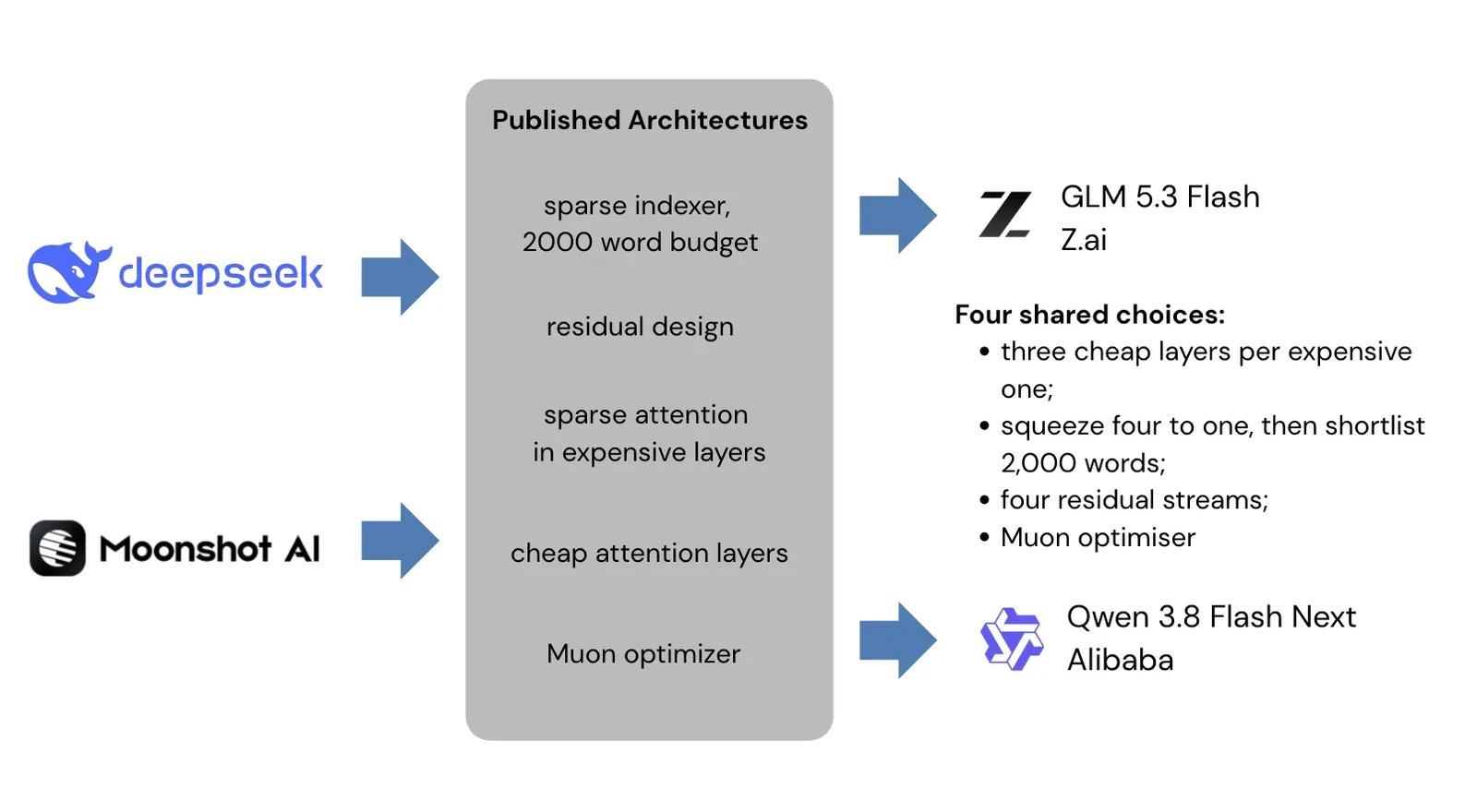
Both run three cheap layers for every one expensive layer. Both narrow the expensive layers to the two thousand most relevant words. Both widen the internal pathway that carries information between layers, from one to four. Both train with the same optimiser, set up the same way.
Both stack the same ratio. GLM runs 45 layers, 34 cheap and 11 expensive. Qwen runs 48, in repeating blocks of 3 cheap and 1 expensive. Both then hand the expensive layers a shortlist rather than the whole document: each squeezes the history 4:1, then keeps the bestt 2,000 words. GLM pools 4 search keys into 1 before scoring. Qwen scores 4-word blocks and keeps the top 512. Different route, but same two numbers.
Both also widen the residual stream, the internal pathway that carries information from one layer to the next, from one channel to four, with gates deciding what each layer reads and writes back. And both train with Muon, an optimiser most labs still do not use, and both break fused matrices apart before Muon touches them while leaving the older optimiser in charge of embeddings and routing.
They part on one choice. GLM removes positional encoding from its expensive layers entirely. Qwen tried the same thing, saw no difference during training, then found the model would not reliably stop generating after fine-tuning, and put it back.
That is not coincidence, and it is not quite independence either. Z.ai's cheap layers come from Moonshot, and its residual design comes from DeepSeek, which also introduced the two-thousand-word budget earlier this year. These labs read each other's papers and ship each other's parts within months.
The beauty of open-source is when knowledge is shared and reused to progress the development of better,faster models than any one lab can manage alone.
What the shared design buys
Speed on long documents. Most models slow down as text grows, because every new word gets compared against everything before it. Doing that in only one layer out of four keeps the cost close to flat. The other three carry a running summary, which costs the same whether the model has read a page or a book.
The numbers follow. Z.ai's GLM-5.3-Flash reads a million tokens at once, about the length of a long novel, and the company says it comes close to Claude Opus 4.8 on coding and agent work at roughly a tenth of what its previous model cost. It carries an MIT licence, so you can use it commercially. Alibaba's Qwen3.8-Flash-Next reads about 262,000 tokens on its own, stretches to a million, and reports processing up to seven times faster at that length.
Both are free to download. For a small team, that means a capable long-context model running on hardware you already own.
Sources: GLM-5.3-Flash on Hugging Face, Z.ai GLM-5.3-Flash docs, GLM-5 Technical Report (arXiv:2602.15763), Qwen3.8-Flash-Next on Hugging Face, Qwen3.8-Flash-Next GitHub
Source: Two Chinese AI Labs Independently Converge on the Same Model Architecture