

The AI That Gives Up Writing to Put Engineers Back in Charge
Jev is not another chatbot. It is a decision model that claims near-frontier judgment on structured tasks, then beats chat models on latency and price by skipping the paragraph.
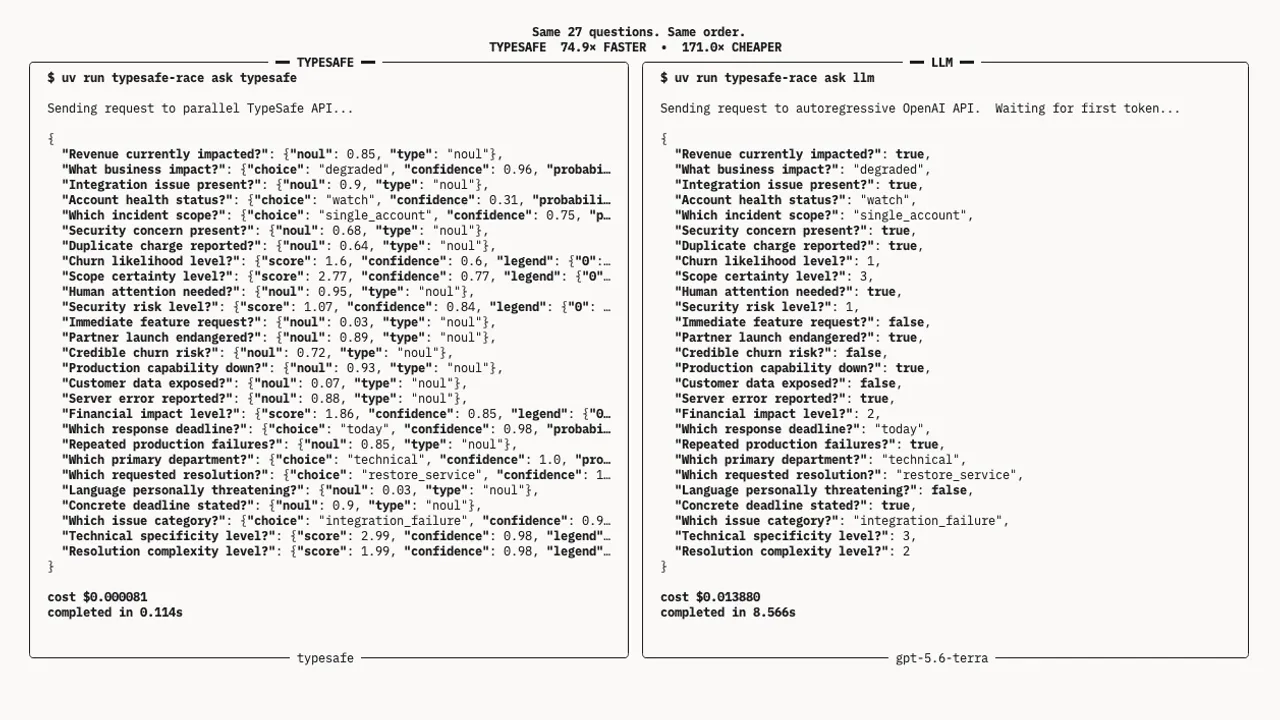
TypeSafe AI’s Jev is built to be fast and cheap on purpose. End-to-end answers usually land between about 70 and 500 milliseconds. Input is priced at roughly $0.042 per million tokens, with output billed as free. On the company’s own decision workflows, the best-case gap versus frontier LLM calls reaches roughly 200x faster and 400x cheaper. But the usage matters: this intelligence is meant to sit inside a tight software loop, not a chat window.
The twist is what it refuses to do. Jev does not write. You send program state and typed questions. It returns typed answers with calibrated probabilities. No essay. No code dump. No apology paragraph.
How smart, against whom
TypeSafe’s public workflow scores put Jev near the middle of the frontier pack on decision-shaped tasks. Averaged across four workflows, Jev lands around 68 percent accuracy, essentially tied with Claude Sonnet 5 and GPT-5.6 Terra, while Claude Opus 5 and GPT-5.6 Sol sit about five to six points higher. The catch is the bill and the clock. Those higher-scoring models cost on the order of one to two orders of magnitude more per case and take many seconds, sometimes more than a minute, where Jev is often under half a second. Early third-party notes also cite a moderation test where Jev beat Gemini Flash-Lite on accuracy at a much lower cost per decision. The gap is not “always smarter than Gemini or Sonnet.” It is “Sonnet-near judgment for System One work, at a price and latency those chat models were never built to hold.”
The founder, Diogo Almeida, helped build the instruction-tuning work behind modern chat models at OpenAI. His new bet is almost the opposite of that era. Chat was never enough for reliable automation. Software needed an interface it could trust.
What you give up, and what you get
Because Jev never samples a free-form token stream, it does not invent labels outside the schema you defined. Choice, Score, and Noul questions return values your code already understands, each with a probability and a confidence score. TypeSafe trains this stack with Reinforcement Learning for Calibrated Decisions (RLCD), not chat preference tuning. All questions in one call are scored in parallel against the same state.
Schema safety is not truth. Jev can still pick the wrong valid option. It will not summarize a document or explain itself. For triage, moderation, tool routing, guardrails, and real-time app loops, a fast typed decision may still beat a fluent wrong paragraph.
Why engineers matter again
Autoregressive GenAI made it easy to hide logic inside a prompt and hope the string parses. Jev pushes the hard work back onto design. You define the decision graph: the enums, the thresholds, the branches, the “ask a human” gates. The model fills fuzzy nodes. Your code owns composition.
Good systems will cascade. Jev routes and scores cheaply. A generative model writes only when writing is required. A person steps in when confidence is low. The intelligence is in the architecture, not in a paragraph that might go off-script three layers deep in a dependency chain.
If chat models were System Two theater for the screen, System One models are for the call stack. The programmers who can name the decisions, constrain the outputs, and measure calibration are not being replaced by the next autocomplete. They are the ones who make this class of AI shippable.
Sources
- Diogo Almeida, “Introducing System One Models & Jev,” TypeSafe AI, 15 September 2026. https://typesafe.ai/blog/introducing-system-one-models-and-jev
- TypeSafe AI product site. https://typesafe.ai/
- Arize AI, “TypeSafe Jev: Can Decision Models Replace LLM Judges?” https://arize.com/blog/typesafe-jev-llm-judge/
- Secondary coverage of TypeSafe’s published workflow scoreboard (Jev vs Claude Sonnet 5, GPT-5.6 Terra/Sol, Claude Opus 5) and early Gemini Flash-Lite moderation comparisons.
Source: Diogo Almeida, Introducing System One Models & Jev, TypeSafe AI