

Japan's Top AI Startup Wants a Brain It Doesn't Have to Borrow
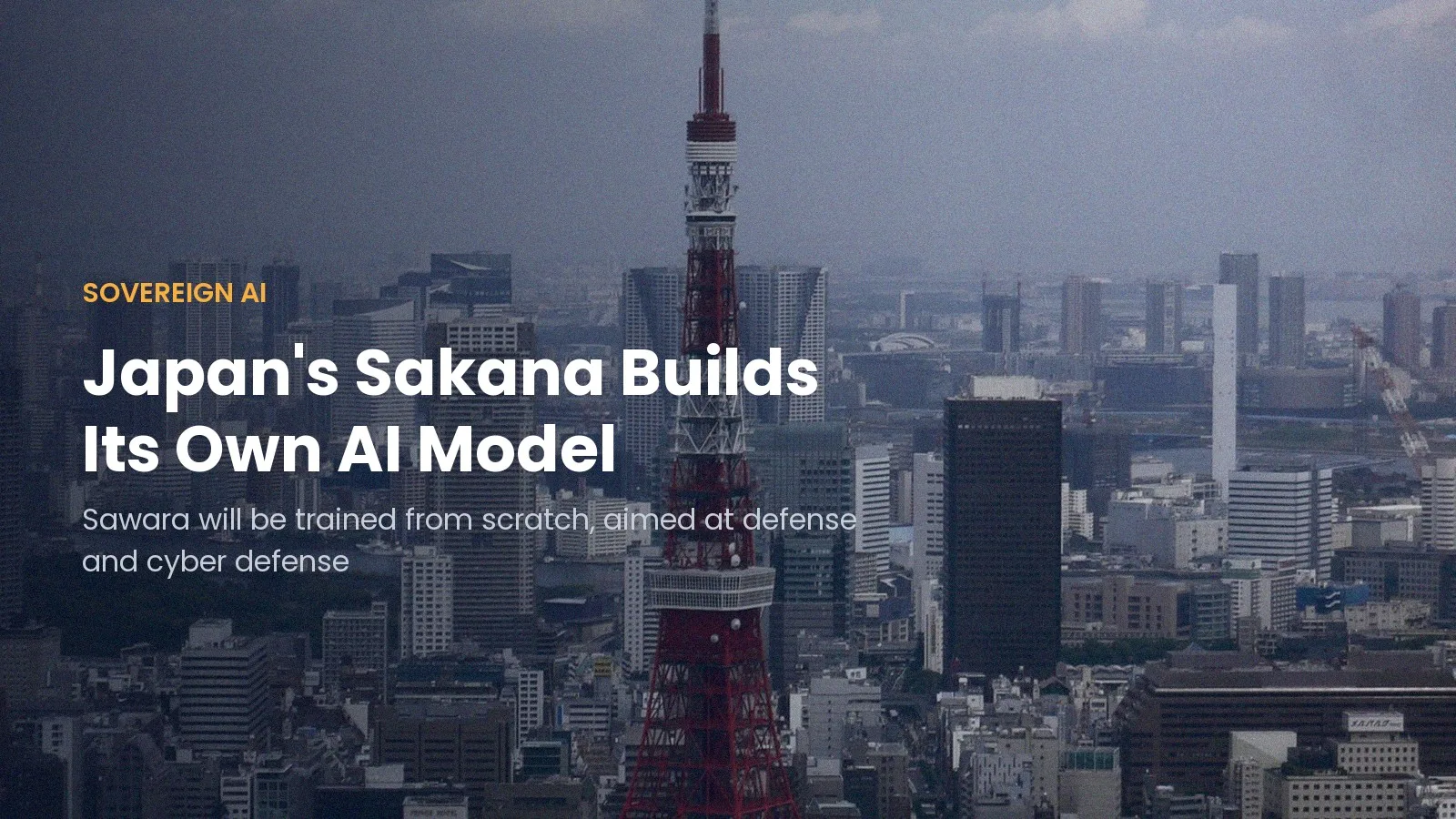
Japan's most valuable AI startup is moving past adapting other companies' models. Its new Sawara project starts from scratch, with defense and cyber defense in mind.
A country can run AI on its own soil and still depend on someone else's model. Sakana AI, Japan's most valuable AI startup, now wants to close that gap.
At a symposium in Tokyo on 26 October, Sakana announced Sakana Sawara, a working name for a model it will train from scratch. "We are now about to start pre-training our own model from scratch," CEO David Ha told the audience, according to Nikkei (translated from Japanese). Development starts in November, a smaller version is due in spring 2027, and a larger one will follow. Nikkei reports that the larger model is expected to reach several hundred billion parameters, which is still smaller than the top US and Chinese models.
Why owning the model matters
Until now, Sakana built its products on top of other companies' work. Its Japanese-language model Namazu is a retrained version of Kimi K2.6, an open model from China's Moonshot AI. Its Fugu system, generally available since June and run in Japan, combines several outside models, and Nikkei notes that this left its performance at the mercy of foreign models. Sawara is meant to give Sakana a model it fully controls.
The target customers are the ones who care most about that control. Sakana already works with Japan's Ministry of Defense and big banks such as MUFG, which is also an investor. In July, Nikkei reports, Sakana signed a contract with the Ministry of Defense for a trial of AI-based intelligence analysis. Sensitive defense, cyber defense and finance work is hard to send through American or Chinese services.
Cyber defense is a growing reason. Nikkei points out that AI is getting much better at finding software flaws, and attackers are using it too, so defenders need models they can trust and control.
Not Japan's first homegrown model
Japan has trained its own models before. The National Institute of Informatics released a roughly 172 billion parameter model trained from scratch in December 2024, with its data made public. What is new is a fast-growing startup betting its business on one, aimed at defense and finance customers.
The open questions
Sakana has about 20 people, which is tiny next to its US and Chinese rivals. It says AI agents will help run its experiments and keep costs down, but that is a company claim, and nobody has tested it yet. It also hasn't said how Sawara will be licensed, sold or measured, what data it will learn from, or whose computers will train it.
The ambition is clear, though. For Japan, sovereign AI is starting to mean owning the model itself, not just the servers it runs on. What to watch: whether the small model ships on time next spring, how it compares with foreign models, and whether the defense ministry becomes a customer.
Sources
- サカナAIが国産AI開発へ 防衛・サイバーに活用、米中依存リスク排除 (Nikkei, Japanese)
- Japan's Sakana AI to build homegrown model to cut US, China reliance (Nikkei Asia)
- Sakana AI Plans Sawara, a Japanese Foundation Model Built From Scratch (AlphaSignal)
- Sakana AI official site
- Sakana AI plans Sawara homegrown foundation model (Magica)
Photo: "Tokyo Tower and around Skyscrapers" by Volfgang, via Wikimedia Commons, CC BY-SA 3.0. Graded and overlaid by PSI, shared under the same license.