

Ornith-1.5 beats Qwen3.6 at coding-agent tasks and runs on one consumer graphics card
Ornith-1.5 is a new open coding model that trains on problems it invents for itself. By its maker's numbers the mid-sized version beats Qwen3.6 at coding-agent tasks, and a compressed build runs on one RTX 3090. What is different, what it gives up, and who should try it.
For developers who run a coding model on their own hardware and want one that finishes terminal jobs unattended.
Ornith released Ornith-1.5 on Aug. 18 and 19, three MIT-licensed coding models in small, medium and large sizes, built on Alibaba's Qwen3.5 and trained on problems it invents itself. By Ornith's own numbers, the mid-sized model beats Qwen3.6 on the two most-watched coding-agent benchmarks, and a compressed version runs on a single RTX 3090 card.
The mid-sized model uses a mixture-of-experts design, which switches on only a small part of the model for each word, so it computes like a model a tenth its size though the whole thing has to fit in memory. It reads images, holds about 200,000 words of context, and is built for agentic coding, where the model runs commands, reads output and picks its next move.
What is different
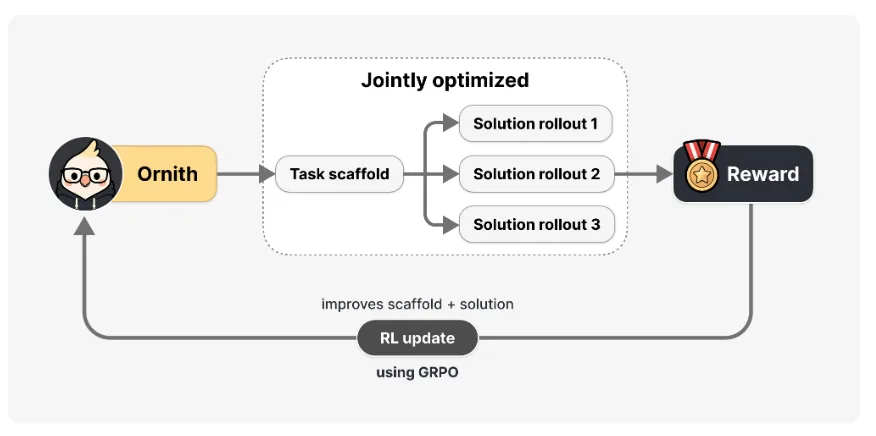
Ornith-1.0 taught the model to write its own game plan, the instructions and tools it will use. In 1.5 the model also invents harder tasks, writes a plan for each, attempts a solution and learns from how it went, a self-improvement loop. Benjamin Marie of Kaitchup wrote, "This effectively closes the loop... What I'm curious about is the training cost."
The gain shows up in behaviour, not raw speed. Max Sun (HelloSun) measured the same text speed for both models, yet "Ornith completed tasks 2.4x to 8.8x faster" inside a coding agent because it read the top of a large log file rather than all of it. Alexey Satonin, after a day of heavy use: "The model is dumb as a rock. But it is persistent and stable".
The trade is general knowledge. Kengo Tanaka found it scored roughly twenty points lower than Ornith-1.0 on a general-knowledge test, Vector Labs warns such loops can degrade sharply outside their training tasks, and Ornith-1.5 is not yet on the independent Terminal-Bench leaderboard.
If you run Qwen3.6 on an RTX 3090 or similar for terminal work, pull the compressed 4-bit download and try it; leave the model's working memory setting uncompressed or tool calls fail. Stay with Qwen or a conventional model for general questions, and skip the largest version without several GPUs.
Verification note. Readers already knew Ornith-1.0 let a model write its own task scaffolds. This adds the closed task, scaffold and rollout loop, vendor-reported scores and independent behaviour tests. Five-minute check: open the 35B-A3B model card, read the benchmark table and footnotes, or run `ollama run hf.co/ornith-ai/Ornith-1.5-35B-A3B-GGUF:Q4_K_M` on a 24 GB card. Tiers: sizes, licence and config, tier 1 (artefact fetched); benchmarks and method, tier 2 (vendor statement); HelloSun and Tanaka results, tier 3 (independent tests).
Sources: Ornith-1.5 blog · Ornith-1.5-35B-A3B model card · Discussion #27, HelloSun speed test · Discussion #26, Tanaka and david lee · Discussion #17, Satonin · Kaitchup, Benjamin Marie · Terminal-Bench leaderboard · GrandCode paper
Source: Ornith-1.5 blog and model card