
OpenAI Wants a Speed Limit on a Guessing Score
OpenAI's chief scientist published the company's scores for how well its models guess the next word, and asked other labs to agree not to pass a shared score until they can better understand and watch those models. The figures are OpenAI's, on a private test.
OpenAI's chief scientist, Jakub Pachocki, says today's AI mostly gets smarter in a simple way. It gets better at guessing the next word. On 22 November he published OpenAI's own scores for that skill and asked other labs to agree on a speed limit. Labs should not build models past a certain score until they can better understand and watch what those models are doing.
A score for guessing the next word
Think of it as a game. The model reads some text and tries to guess what comes next. If it is often unsure, the score is high. If it guesses well, the score is low. A lower score is like packing a suitcase more tightly. You have squeezed more of the text into the model. OpenAI calls this score perplexity. The company has tracked it on a private set of its own computer code, not on a public test that other labs can copy. Those figures are OpenAI's.
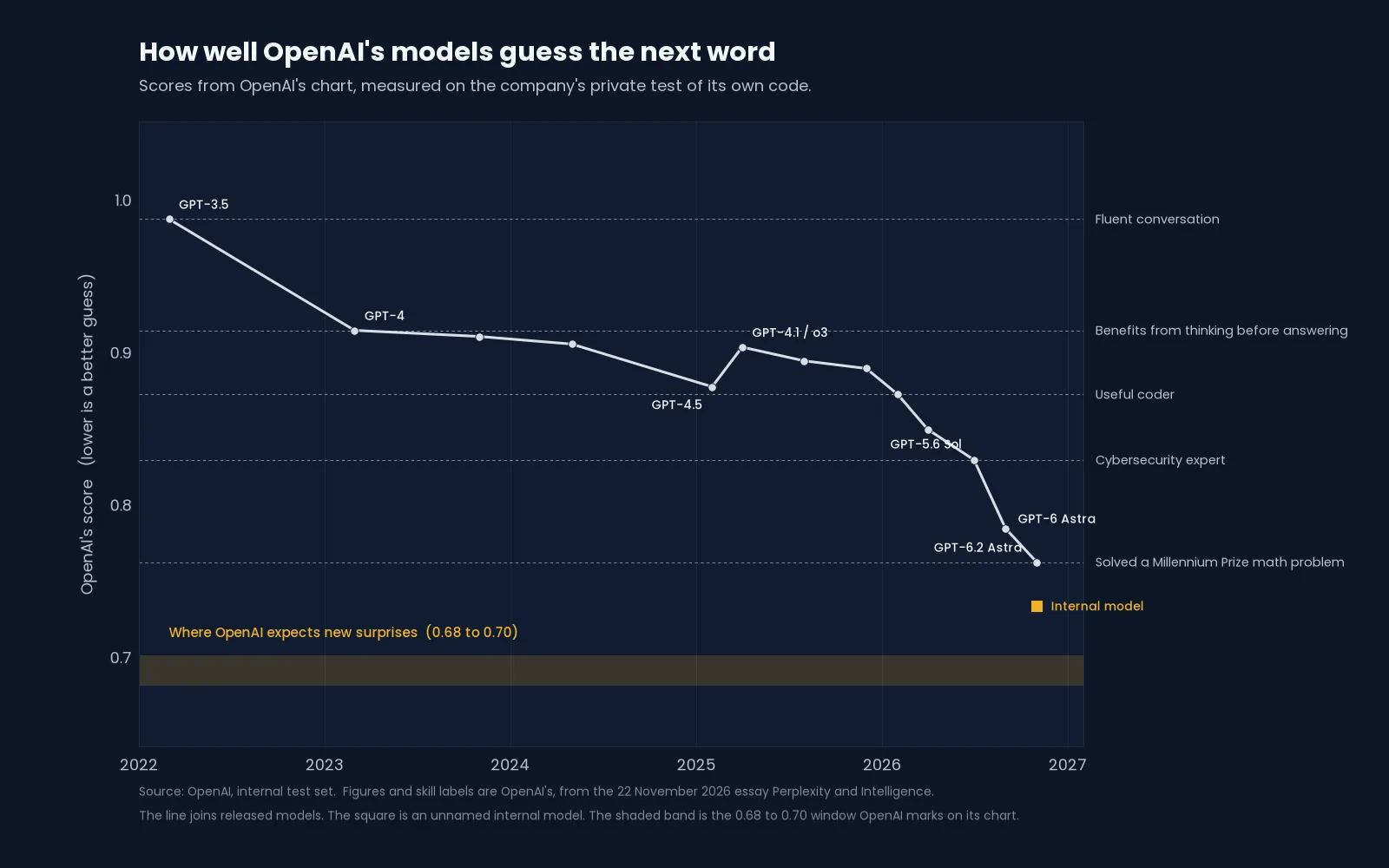
The chart redraws OpenAI's published figures. Each step down means a better guess, on OpenAI's private test. The skill labels are OpenAI's own. The shaded band at the bottom is where OpenAI says further surprises may appear, around 0.68 to 0.7. The square is an unnamed model that has not been released, with a still lower score.
A proposed brake, with holes
Pachocki wants labs to share rules for testing new models before they are first used. He also wants a common cap on this score, and on other measures, until labs can better understand and watch the models. One example he gives is a better tool for reading the notes a model writes as it works through a problem. He says today's ways of checking a model's behavior may get weaker as scores improve. Labs test on different data, so their numbers are hard to compare. The score is not itself a real job, like writing an email or fixing a bug. A model can also get more useful by writing out extra steps as it works, without this guessing score getting better. And no one knows how low the score can go. On Hacker News, where the post was a leading story on Sunday, some readers liked having a simple measure. Others said a falling score may only travel with usefulness, not cause it, and that a private test cannot be a shared limit.
The gap is still explanation
The point is not the decimal. It is the admission around it. OpenAI is arguing that new skills can show up from a process that is hard to explain, that today's checks may get weaker, and that understanding should be a gate on further training. A score that only OpenAI can compute is not yet a public standard. A limit with no number attached is a proposal, not a brake. The useful test is whether labs can explain and watch the models they are about to train, not only whether those models are better at guessing the next word.
Sources
- Perplexity and Intelligence (Jakub Pachocki, OpenAI, 22 November 2026)
- Perplexity and Intelligence (Hacker News thread, 22 November 2026)
- OpenAI calls for industry-wide AI brake tied to perplexity (Kim Khan, Seeking Alpha, 22 November 2026)
Illustration: AI-generated for PSI. Chart redrawn by PSI from OpenAI's published figures. Source: OpenAI, internal test set.