

If You Hand an AI Agent Your Bank Login, the Risk Is Yours
Citi, JPMorgan Chase and PNC have updated their digital agreements so that a third-party AI agent using your login is treated as you, even if the login later leaks. Bank of America has warned customers by email.
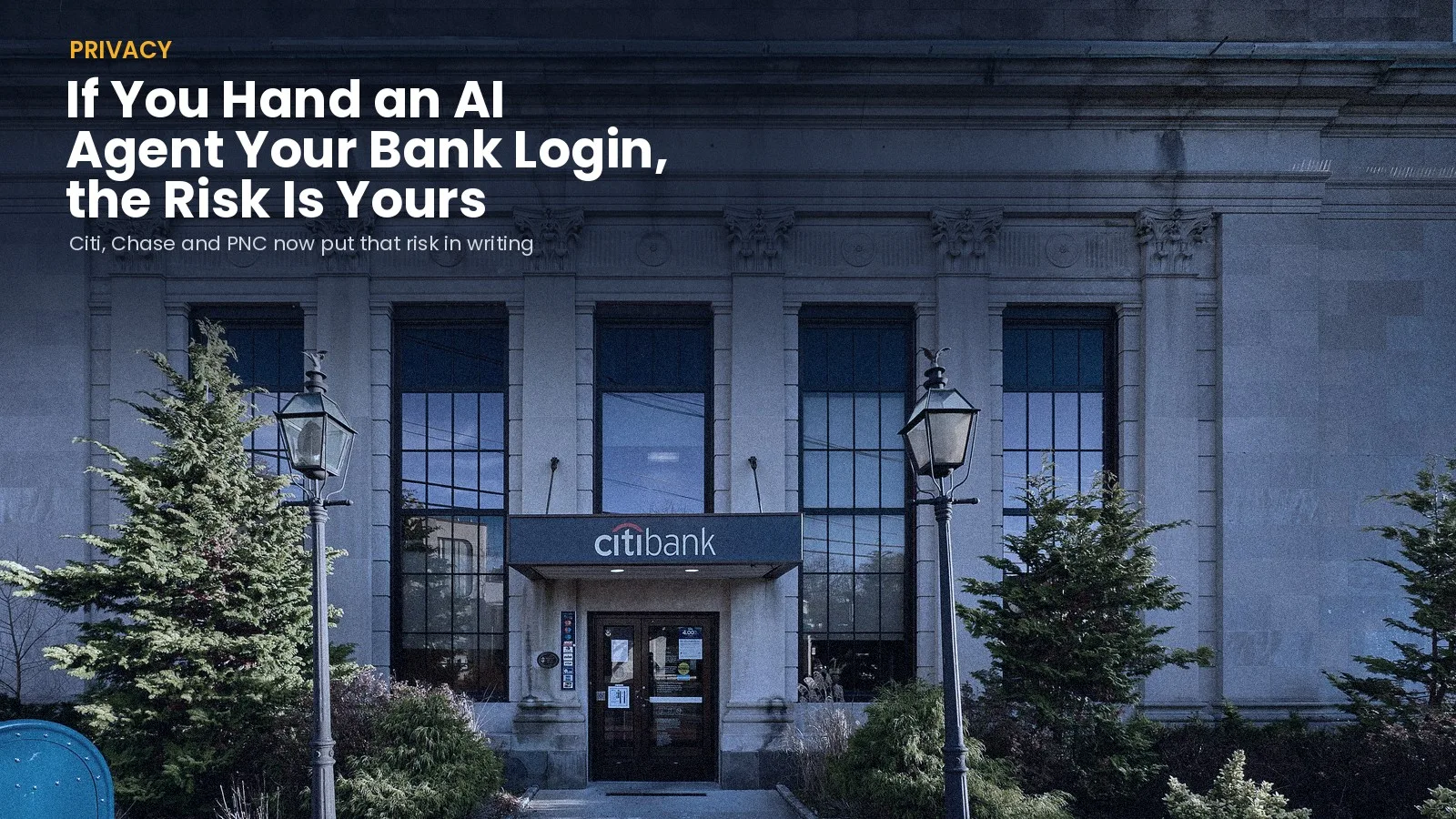
Citi has updated its online agreement so that a third-party AI agent using your login is treated as you. If the agent errs, or if the login later leaks, Citi says it will treat the activity as authorized. JPMorgan Chase and PNC have put similar rules in their digital agreements. Once you hand an outside agent your banking credentials, the bank wants the risk to sit with you.
What Citi's new terms actually say
Citi added a new Section H on third-party AI agents to its Online User Agreement in November 2026. If you give an agent your online credentials, or let it into your accounts, Citi says it will treat the agent's actions as authorized by you. The same rule applies if those credentials are later shared, leaked, or passed on. Citi says it has no duty to check whether the agent followed your instructions, and that you must monitor what it does. Letting an agent in also authorizes Citi to disclose your information, including sensitive personal information, to that agent, and Citi's privacy notice does not cover how the agent then uses or shares that data. The new section does not apply to tools Citi itself provides. How existing consumer protections apply when a customer's own agent acts is not yet settled.
Other banks are drawing the same line
JPMorgan Chase's Digital Services Agreement, with changes effective 27 October 2026, bans third parties, including what it calls "External AI," from using a customer's login. Approved tools may still connect through the bank's own interfaces. If you still permit an outside agent to use your login, Chase says you authorize it to transact and are responsible for errors, unintended payments, and any later sharing of your information. PNC's terms say customers must not give an agent a user ID, password, or one-time passcode. Agents may connect only through methods PNC makes available, and they generally may not start payments unless PNC expressly allows it. To the extent the law permits, PNC says you are responsible for activity you allow in violation of those rules, including unintended actions. Bank of America emailed customers in late October not to share passwords with an "AI-enabled tool or agent," and said they are responsible for activity that follows. TechCrunch reported that it had seen a similar warning from Citizens the week of 18 November.
The risk starts when the login leaves your hands
An agent given a bank password can see, and sometimes move, money. Citi's terms treat a later leak of that password as still authorized. Anthropic says the personal finance feature it launched in early November in Claude is read-only, connects through Plaid, and "can't move, manage, or invest your money." That is a company claim. Agents that run on a device you control, and that never need your banking password, reduce the chance that a login is copied or leaked. If you let a third-party agent act in your name, the bank will try to treat the result as yours.
Sources
- Citi Online User Agreement (Citi, updated November 2026, Section H)
- More banks say customers using AI agents are on their own, even if they get hacked (Tim Fernholz, TechCrunch, 18 November 2026)
- Digital Services Agreement (JPMorgan Chase, last updated October 2026, changes effective 27 October 2026)
- Digital Services Agreement (PNC, Third-Party AI Agents section, retrieved 22 November 2026)
- Bank of America kindly asks that you don't share your banking password with your AI assistant (Zack Whittaker, TechCrunch, 27 October 2026)
- Introducing Personal Finance in Claude (Anthropic, November 2026)
Photo: "Citibank, Great Neck, New York, Dec 29 2022" by D. Benjamin Miller, via Wikimedia Commons, CC0 1.0. A Citibank branch in Great Neck, New York, 29 December 2022. Graded and overlaid by PSI.