

Can Water Break Math? The Navier-Stokes Mystery, Explained
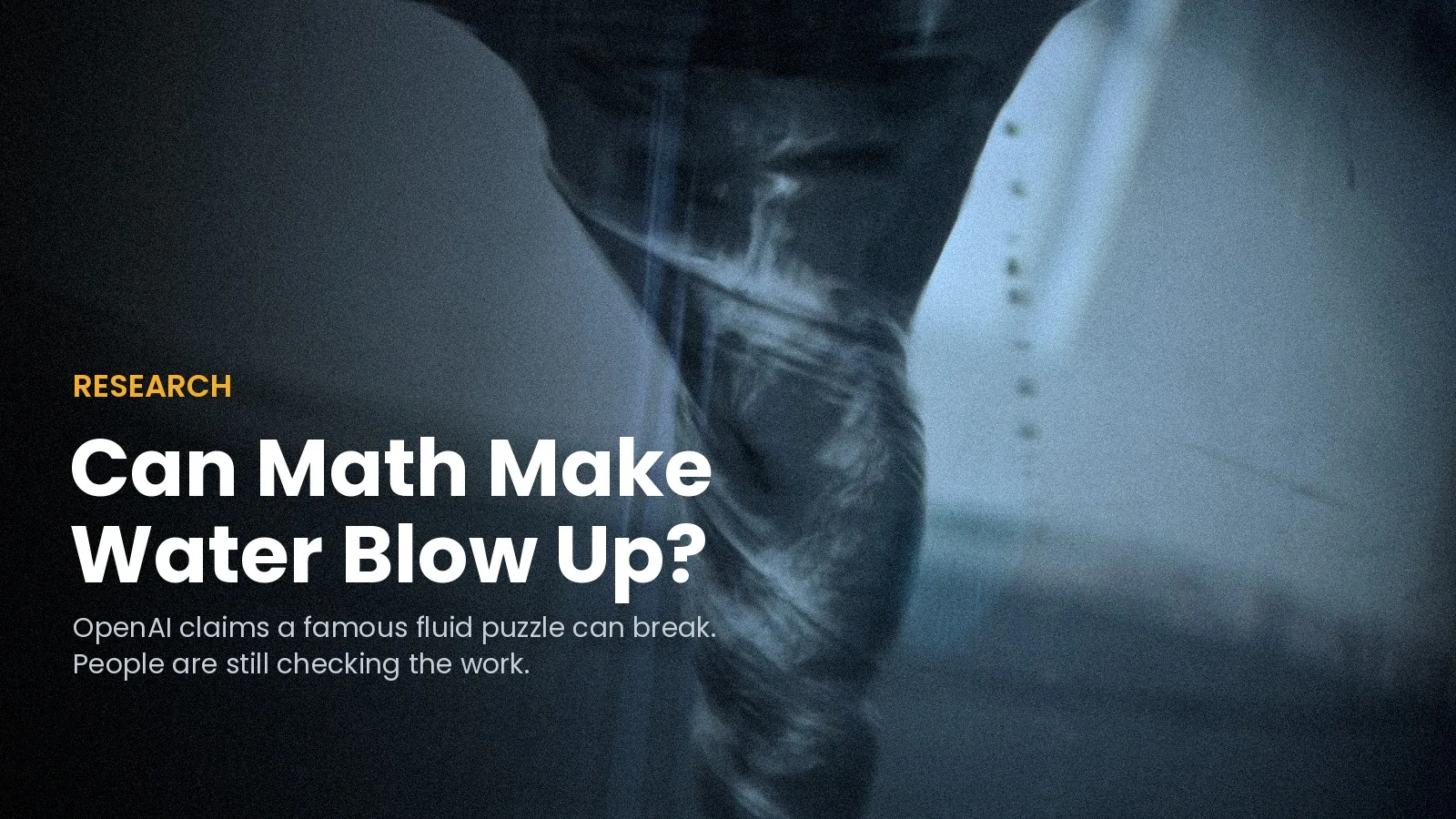
OpenAI says one of its AI systems found a way for a famous math recipe about flowing water to "blow up." In a blow-up, the math says a swirl can get faster and faster until its speed has no limit, all in a short time. Real water cannot do that. The company shared a long writeup and a version written for a computer to check. Other mathematicians are still reading it, and the million-dollar prize has not been awarded.
What the equations do
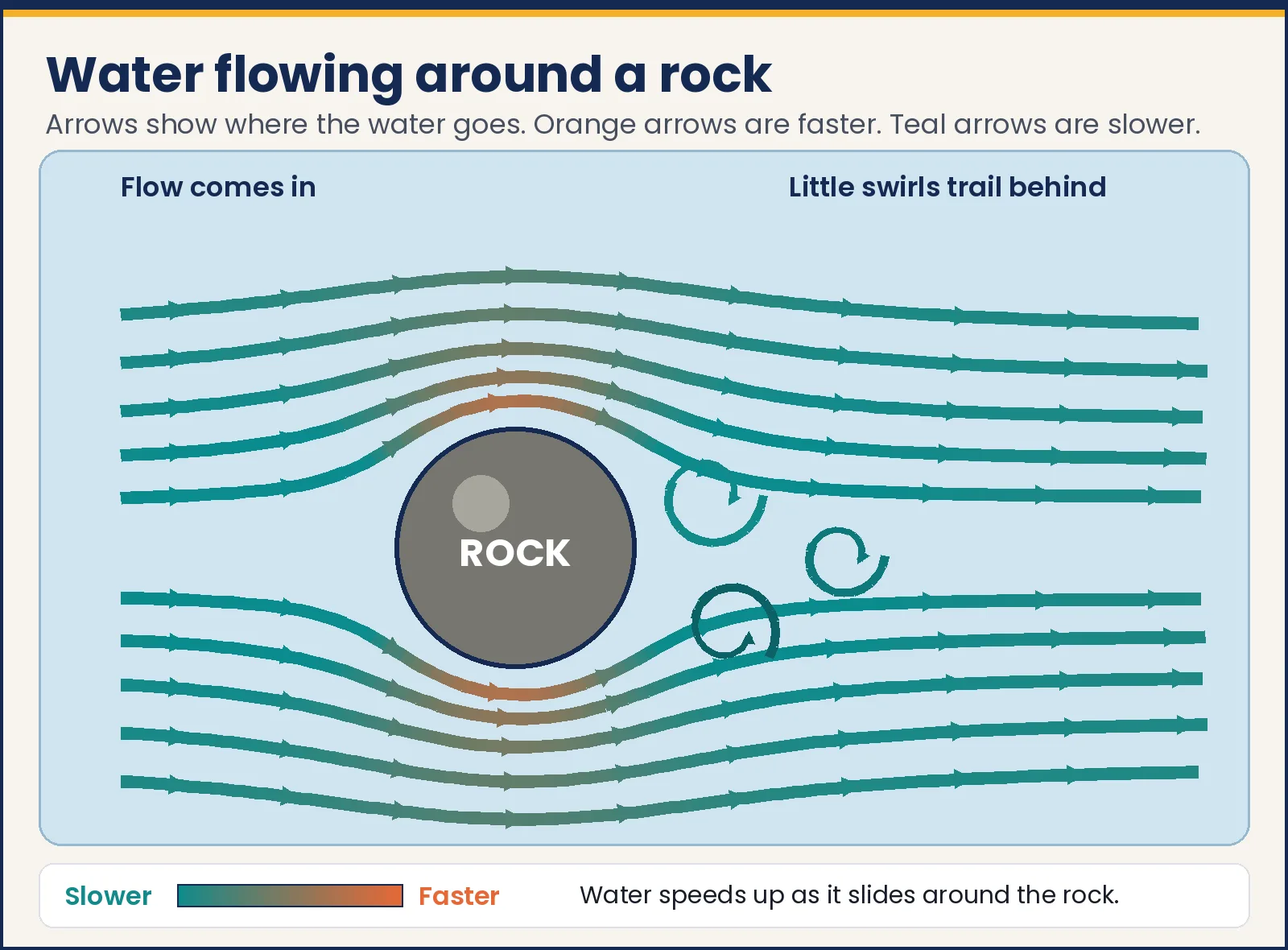
When you stir a bathtub, the water does not hop about as separate drops. It slides as one flowing stuff. Smoke from a candle does the same in air. So does the wind that wraps around a bike.
The Navier-Stokes equations are a math recipe for that kind of flow. They are named after Claude-Louis Navier and George Gabriel Stokes, who wrote them in the 1800s. The recipe does not track every tiny water molecule. It treats the fluid as a smooth, continuous stuff, like a moving blanket.
The recipe keeps track of four main things.
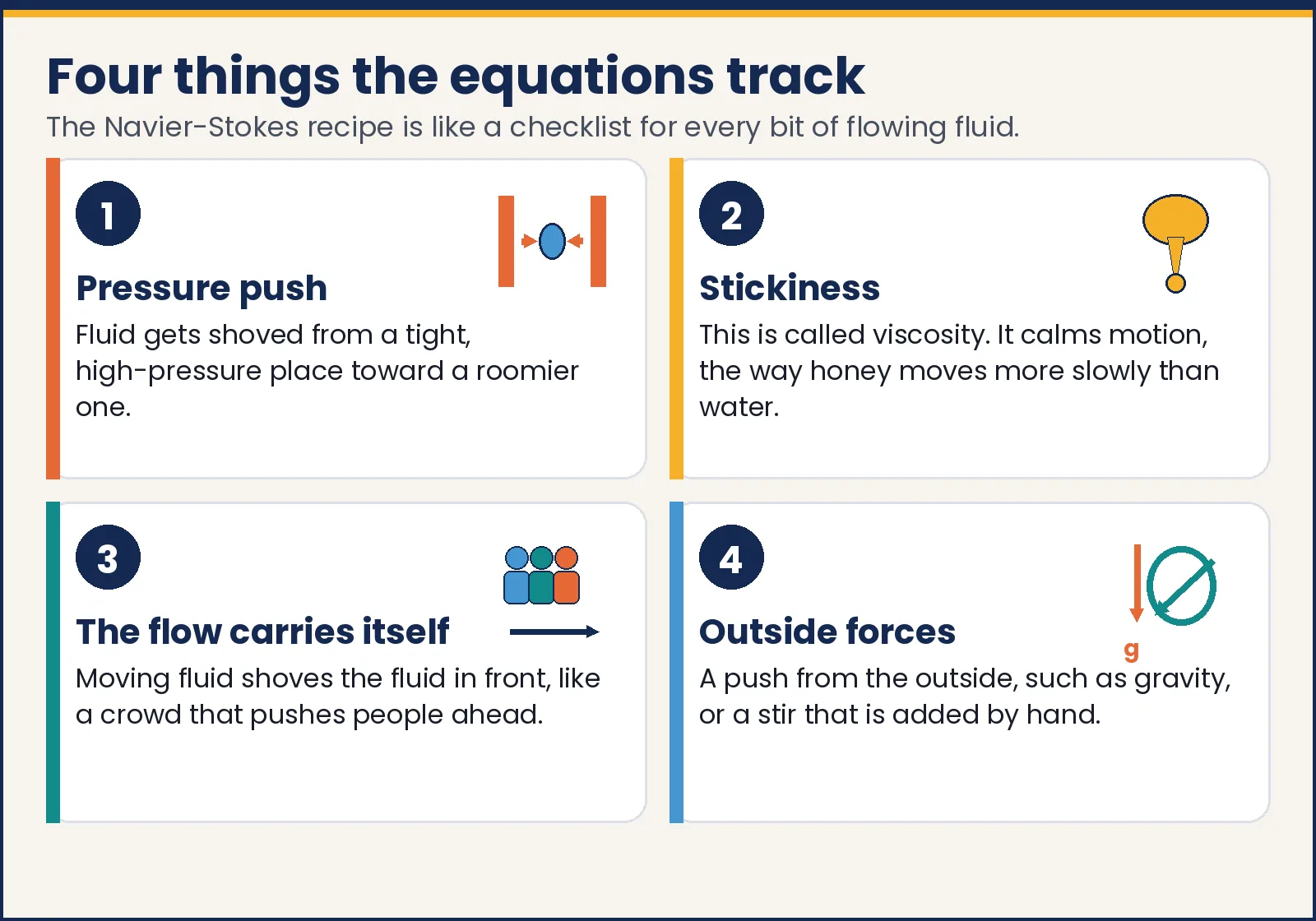
Pressure can push fluid from a squeezed place toward a roomier one. Stickiness, called viscosity, tries to calm the motion, the way honey moves more slowly than water. The flow also carries itself along, like a crowd that shoves the people in front. Outside forces can push too, such as gravity, or a stir from the outside.
Engineers use them to study air around planes, weather, and blood in the body. The deep puzzle is about what the math itself is allowed to do.
Why this puzzle is famous
In 2000, the Clay Mathematics Institute named seven very hard math questions the Millennium Prize Problems. Each one carries a prize of one million dollars. One of them asks about Navier-Stokes flows in three dimensions.
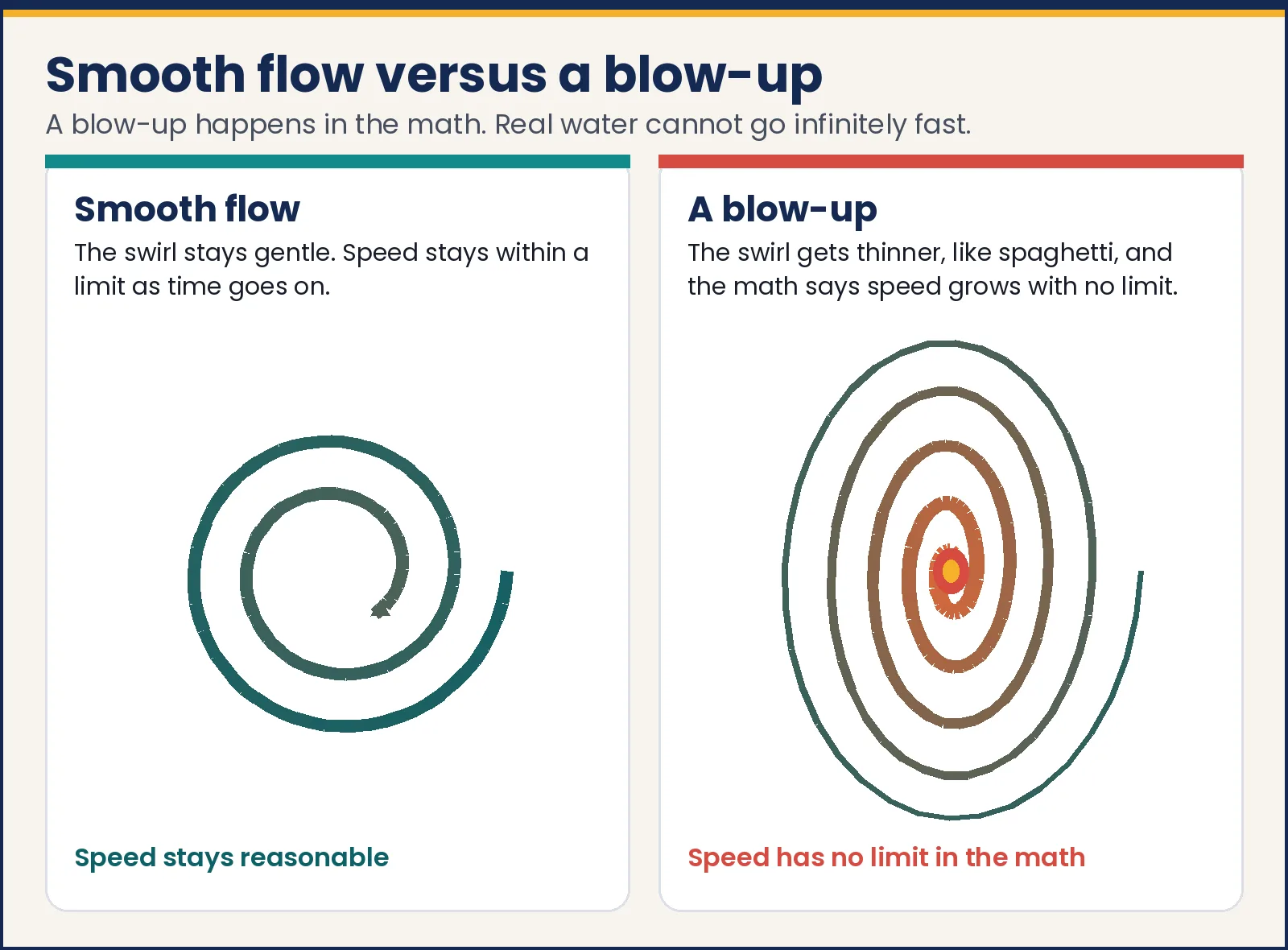
The question is not whether water moves. It is this. If a flow starts out smooth and gentle, can the math ever break down? In a breakdown, also called a singularity or a blow-up, speeds grow without a bound in a limited amount of time.
Stickiness usually helps keep things smooth. In 1934, Jean Leray proved that a weaker kind of solution exists. Whether a smooth start must stay smooth forever stayed open for about 90 years.
OpenAI says a blow-up would mean the recipe has reached a limit, and scientists might then need a different picture of the real world.
The official prize question allows a smooth push from the outside, like a carefully chosen stir that never itself becomes infinite. OpenAI's writeup is about that version, not a blow-up with no outside force at all.
What the AI says it found
On September 8, 2026, OpenAI said an internal AI system, one it describes as stronger than GPT-6 Astra, produced a proof of blow-up. The 166-page writeup says the fluid starts at rest, a smooth force is applied, and the energy of the whole fluid stays finite. In a shrinking swirl, the speed still grows without a bound in a finite time. The company says this settles official prize statements C and D.
OpenAI describes the flow as a vortex, a spinning swirl, that spirals inward and gets stretched like spaghetti. The middle gets thinner as it speeds up. The hard part, the company says, is that the breakdown has to come from the fluid's own motion, not from anyone putting in an infinite force by hand.
The company also shared some work numbers, which have not been independently checked. It says about 10,000 agents reached a resolution in about 88 hours, and that putting the argument into Lean, a computer language used to check proofs, took 17 more hours with GPT-6 Astra. OpenAI says it does not intend to claim the Millennium Prize.
How a proof gets checked
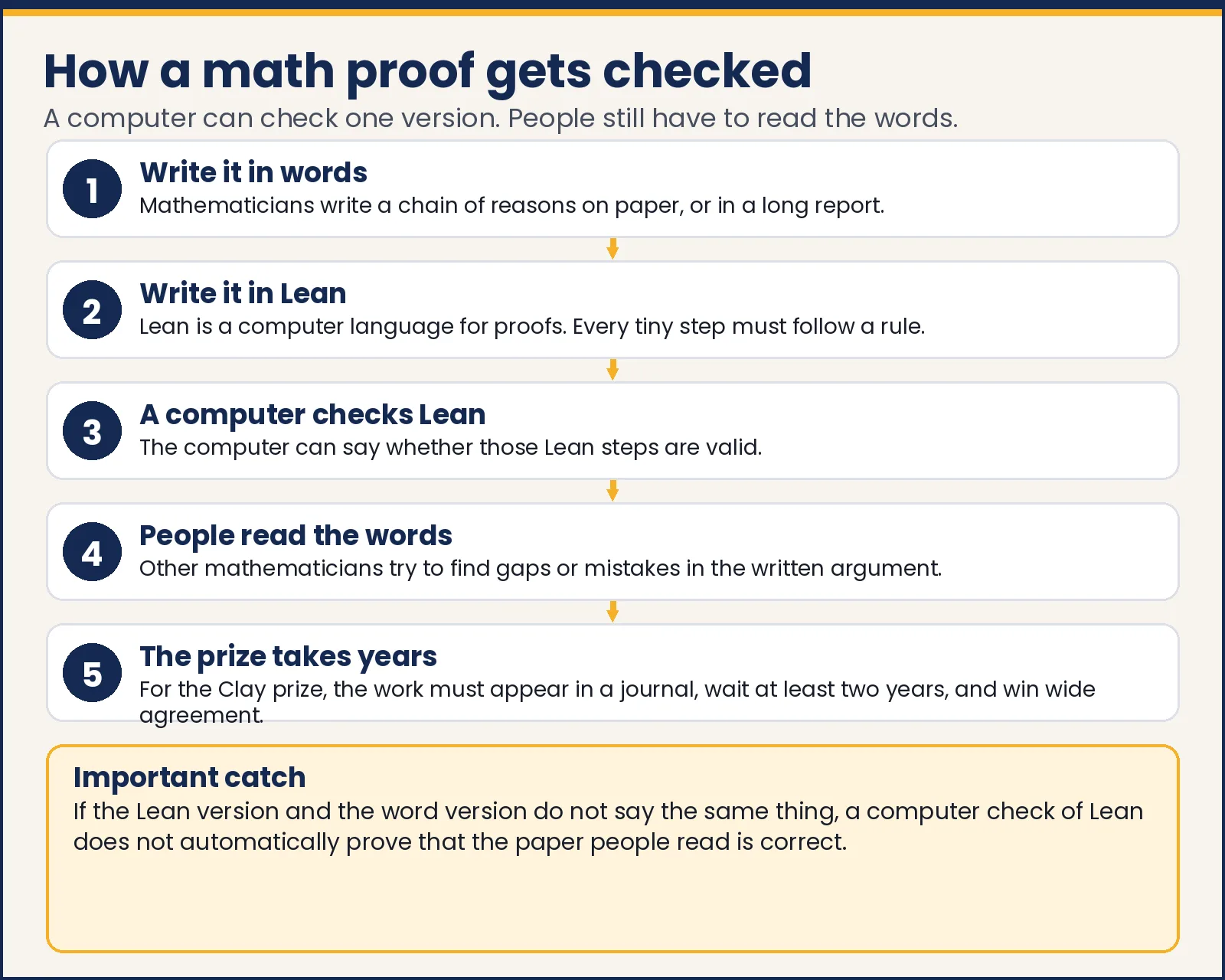
A math proof is a chain of reasons that is supposed to leave no gaps. People write it in words and symbols so others can read it. They can also write a version in Lean, which a computer can check step by step.
Those two versions need to match. If they do not, a computer saying "the Lean steps work" does not automatically mean the paper people read is correct.
In October, mathematicians at King's College London and the University of Cambridge reported that OpenAI's Lean version does not fully match the written paper. Their report is a draft, not yet checked by a journal. They do not say the claimed result is wrong. They say the Lean check cannot stand in for a careful reading of the words.
On September 11, 2026, the Clay Mathematics Institute said the Navier-Stokes problem "has apparently been settled." That note named no person and no company. Clay's rules are slow on purpose. Before it will even consider a prize, a solution must appear in a qualifying journal, at least two years must pass, and the result must win general acceptance among mathematicians.
Experts are still working through the long writeup. The honest summary is simple. An AI company has offered a detailed argument that this fluid recipe can blow up, under a smooth outside push. A computer has checked a formal version of an argument. People are still comparing the versions, and the prize has not been awarded.
Sources
- On the Navier-Stokes Millennium Prize Problem (OpenAI, 8 September 2026)
- Finite Time Blowup for Navier-Stokes (OpenAI paper, 166 pages)
- Lean formalizations of the Navier-Stokes and Euler results (OpenAI GitHub repository)
- Existence and Smoothness of the Navier-Stokes Equation (official Millennium Prize problem statement by Charles L. Fefferman)
- Navier-Stokes Announcement (Clay Mathematics Institute, 11 September 2026)
- Rules for the Millennium Prize Problems (Clay Mathematics Institute)
- Navier-Stokes lost in translation (A. Bastounis, F. Circelli and A. C. Hansen, preprint)
- OpenAI's Navier-Stokes proof called into question (King's College London, 27 October 2026)
- OpenAI's blockbuster Navier-Stokes proof isn't what we thought it was (Scientific American, 13 October 2026)
Photo: "Water vortex" by Carlos Adampol Galindo, via Wikimedia Commons, CC BY-SA 2.0. Graded and overlaid by PSI. Diagrams by PSI.