

Mistral just shrank the AI safety filter down to one graphics card
Mistral has released Shieldstral, a 3-billion-parameter, open-weight safety model that runs on a single graphics card with 16 GB of memory and, by Mistral's own numbers, matches or beats moderation models up to seven times its size.
A 3-billion-parameter guard model that takes its policy from you
Mistral announced Shieldstral 1.0 last Tuesday, August 4, and put the weights on Hugging Face under an Apache 2.0 license. It was the most significant small-model release of the past week, and with the weekend quiet (Alibaba's promised smaller open-weight Qwen sibling is still pending), it remains the story builders should be looking at.
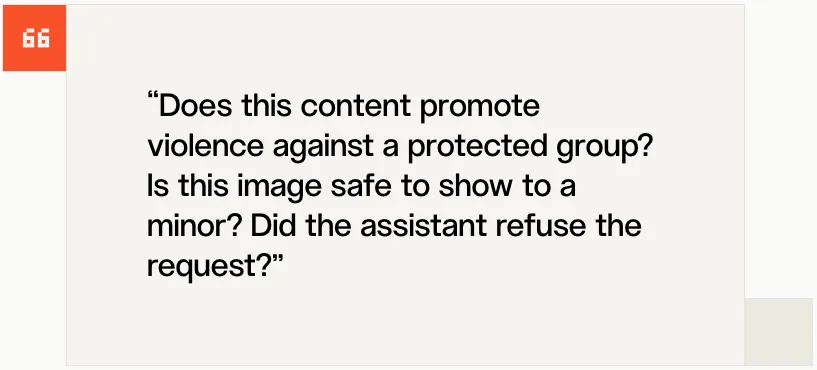
Shieldstral is a safety classifier: the model that sits in front of (or behind) your actual product and decides whether a prompt or a response crosses a line. The twist is that no harm categories are baked into its weights. Instead, moderation is framed as question-answering. You give the model your policy as an instruction, a yes-or-no question, and the content to judge. One forward pass returns a calibrated probability rather than a fixed label.
It also handles images, alone or alongside text, using the vision encoder from Mistral's Pixtral models, so one small model covers moderation for both. A technical paper is up on arXiv.
The safety layer just stopped being an infrastructure problem
Every team shipping an AI product needs a moderation layer, and until now the practical choices were a paid cloud moderation service, which adds cost and latency and sends your users' content to someone else's servers, or open guard models that are considerably bigger, topping out around OpenAI's 20-billion-parameter open safeguard model.
A 3-billion-parameter model that holds its own changes the deployment math. The safety check can now run on the same machine as your product, or on modest edge hardware, instead of being its own infrastructure problem.
The policy-as-prompt design matters just as much. When your rules change, whether that's a new market, a new regulator, or a new abuse pattern, you edit a text file. You don't retrain or swap models.
And because the model returns a probability instead of a verdict, you choose the threshold. Strict for an education app, looser for a security research tool. Same model, different dial.
Permissive license, familiar stacks, and benchmarks that are Mistral's own
The license is Apache 2.0: permissive, with no revenue caps. That's worth noting because several recent small-model releases have shipped with licenses that restrict commercial use above a revenue line.
It runs in the stacks local builders already use: vLLM, llama.cpp, SGLang, and Hugging Face Transformers.
The headline claim, matching or outperforming guard models up to seven times its size, is Mistral's own benchmarking against rivals including OpenAI's open safeguard model, Meta's Llama Guard, and Google's ShieldGemma. Treat it as self-reported until independent evaluations land.
Mistral is candid about the gaps: coverage is uneven outside English, very long documents are shakier, and deliberately obfuscated content can still slip past it.
Bottom line: a safety layer for the price of one graphics card, once you verify it
If you run AI on your own hardware, you can now add a policy-adaptive safety layer for the price of a mid-range graphics card. But test it against your own policy and your own worst-case inputs before you trust the headline numbers.
Sources
Primary: Introducing Shieldstral (Mistral AI) (announcement, August 4, 2026) · Shieldstral-1.0-3B model card (Hugging Face) (weights, license, benchmarks, limitations) · MarkTechPost coverage (August 7, 2026) · Seeking Alpha. Verified against the primary announcement and model card: date, 3B parameter count, Apache 2.0 license, 16 GB memory requirement, policy-adaptive design, multimodal support. The "up to 7x its size" performance claim is Mistral's self-reported benchmarking.
Source: Mistral AI (August 4, 2026)