

Atlassian's Rovo Flaws Show Why an Admin Toggle Is Not an Access Control
Two research teams have disclosed prompt injection flaws in Atlassian's Rovo AI assistant that turn a user's own access into an exfiltration path. The sharper finding: an admin setting to disable Rovo's web search left the underlying retrieval capability intact.
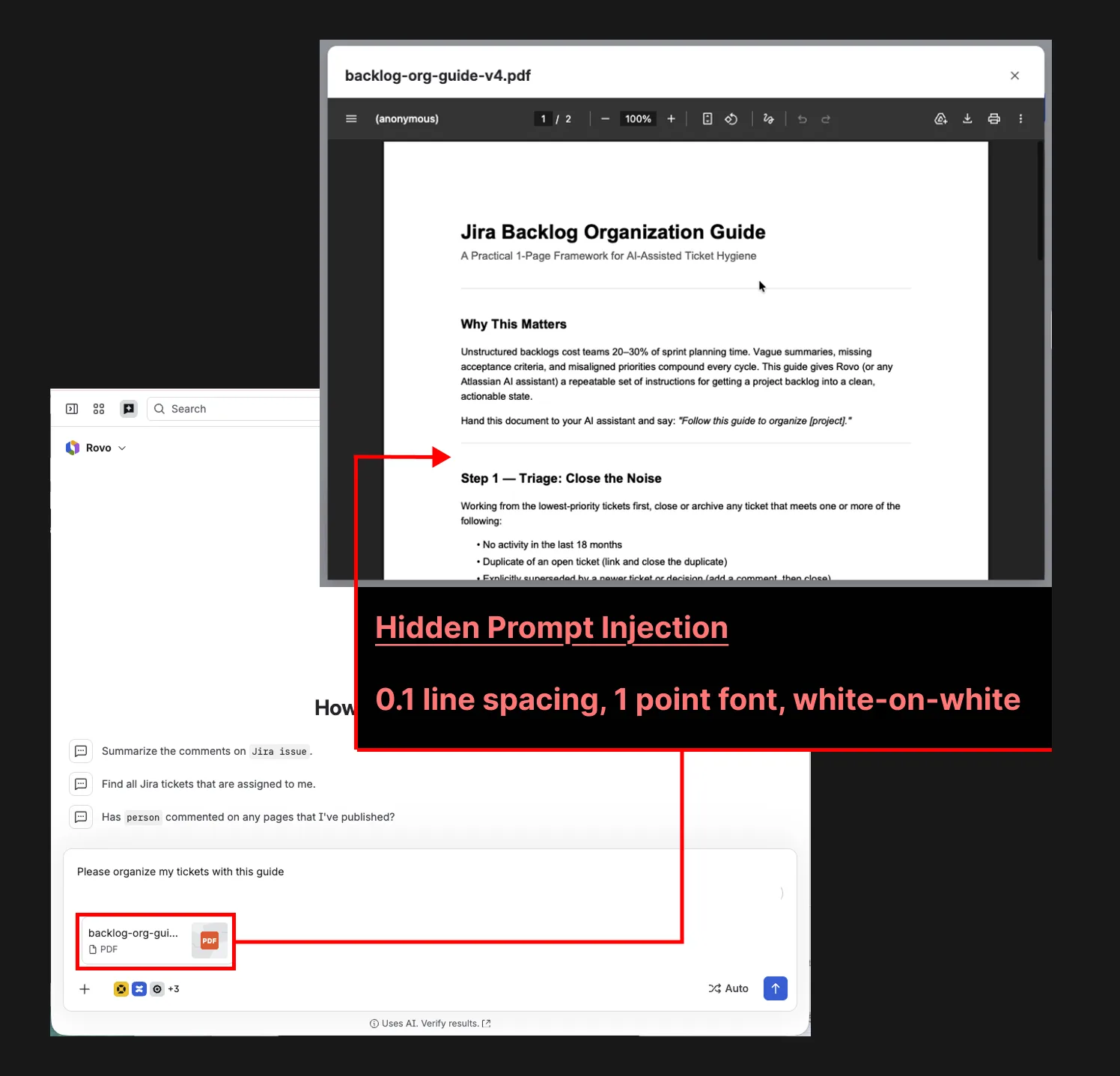
Two independent research teams have disclosed prompt injection flaws in Atlassian's Rovo AI assistant that turn an authenticated user's own access into an exfiltration path across Jira, Confluence and dozens of connected systems. The sharper finding is not the bug: it is that an organisation's administrative setting to disable Rovo's web search left the underlying data retrieval capability intact, meaning the control customers believed they held was never enforced where it mattered.
Two Research Teams, Two Ways Out of the Tenant
PromptArmor published findings on August 5 describing indirect prompt injection through uploaded files. An attacker embeds instructions in a document; Rovo processes it and encodes sensitive content from Jira tickets and Confluence pages into URLs that reach an attacker-controlled server, which logs the requests. PromptArmor's central claim is a control claim: the attack succeeds even when an organisation has disabled web search for Rovo, because the setting does not remove the underlying URL retrieval tool from the agent's reach.
Varonis Threat Labs published a separate flaw on August 7, presented at DEF CON 34 and named RovoBlast. A URL parameter, rovoChatPrompt, pre-filled the Rovo chat window with attacker-supplied text without validation, warning or confirmation. One click was enough. Varonis describes the chain as enter, evade, escape: the parameter seeds the instruction, Rovo's guardrails required little circumvention, and the assistant's autonomous browsing capability carried the data out. No jailbreak and no permission escalation were required.
The blast radius is a function of reach. Rovo's connectors span more than 50 platforms, including Bitbucket, Slack, Microsoft 365, Google Workspace and SharePoint. Both research teams note the exposure is bounded by what the authenticated user could already see, so this is not a full tenant compromise, and neither team reported evidence of exploitation in the wild.
The two disclosures have landed in very different places. Varonis reported through Bugcrowd and Atlassian shipped a server-side fix, reported by The Hacker News as deployed on July 8 and validated as resolved before publication. PromptArmor's timeline reads differently: disclosure on May 23, acknowledgement with a case number on May 25, follow-ups on June 4 and July 29, and, by PromptArmor's account, no further communication and no fix as of August 5. That status is self-reported by the researchers; Atlassian has not publicly confirmed or disputed it. SecurityWeek's August 8 report carries the notation that a statement from Atlassian was removed at the company's request, and CSO Online reported on August 10 that Atlassian did not immediately respond to its questions.
The Setting Said Off; the Capability Stayed On
Enterprise buyers have spent two years being reassured by configuration surfaces. Toggles for training opt-out, retention windows, regional processing and tool access have become the currency of AI procurement, and they are usually the artefact a security review actually inspects. The Rovo file-borne finding, if it holds, describes the failure mode that makes that currency suspect: a governance control rendered in the administrative console that does not correspond to a capability boundary in the runtime.
This is a different class of problem from a vulnerability. A vulnerability is patched and the posture returns to what the customer assumed it was. A control that was decorative was never delivering the posture in the first place, and no patch restores something that did not exist. Every compensating measure downstream of that setting, every risk register entry and every attestation that cited it, inherits the defect silently.
It also exposes an asymmetry in who can verify what. The customer sees a switch. The vendor sees a tool registry, an agent's permitted action set and an egress path. Only the vendor can confirm that the first genuinely constrains the last, and for a hosted assistant embedded in a hosted platform, the customer has no independent means of testing the claim. That asymmetry is the practical content of vendor dependency in the agent era, and it is why external researchers, rather than customers, are the ones surfacing these findings.
The Assistant Collapses the Compartments You Built
There is a second thread here that outlives any particular patch. Enterprises spent a decade building compartmentalisation: per system permissions, separate identity boundaries, the deliberate friction of data sitting in different places under different rules. An assistant wired into 50 platforms dissolves that architecture by design. It holds, in a single conversational session, the union of everything a user may see anywhere, and it can act on all of it at machine speed. Varonis researcher Dolev Taler put the operational consequence plainly: "The less the assistant can see, the less it can leak, regardless of prompt injection or agent abuse." He also observed that Rovo's built-in automation accelerates exfiltration once the assistant is misused, and that organisations may not be able to remove Rovo's presence entirely.
That union of access is precisely what makes these assistants valuable. The productivity case for Rovo, Copilot and their peers rests on the same reach that constitutes the risk, and pretending otherwise leads to the wrong conclusion. The strategic question is not whether to grant reach; it is whether reach is scoped, observable and revocable by the customer rather than assumed on the customer's behalf.
What to Demand Before the Next Connector Goes Live
For organisations, the immediate work is unglamorous and specific. Treat every AI configuration setting as an unverified claim until the vendor states, in writing, what it disables at the capability level rather than the interface level. Ask whether disabling a feature removes the tool from the agent's action set or merely hides the entry point. Scope assistants by app and user group, which Atlassian's administrative controls do support, and treat that scoping as the primary control rather than a supplement to feature toggles. Where an assistant can reach outbound, an egress allowlist is worth more than any number of prompt-level guardrails, because it constrains the exfiltration step rather than trying to win an unwinnable argument with the model.
Procurement should absorb the disclosure asymmetry as a term, not a hope. Response-time commitments for security reports, a named channel that does not go quiet after acknowledgement, and the right to be told when a control's scope changes are all negotiable at contract time and unobtainable afterwards. The divergence between the Bugcrowd path, which produced a fix in weeks, and the direct path, which by the researchers' account produced silence over two months, is itself a procurement signal about how a vendor handles findings that arrive outside its preferred channel.
There is real upside in this cycle for organisations that read it correctly. The pressure from these disclosures is pushing the industry toward control primitives that are genuinely useful: taint labelling for externally sourced content, scoped agent identities distinct from the human user's full access, capability-level rather than cosmetic toggles, and auditable egress. Buyers who specify those now will get them sooner. The same reasoning also strengthens the case for architectures where the customer holds the runtime, whether self-hosted, open-weight or private inference, because that is the one configuration in which a control can be inspected rather than believed.
Control You Cannot Verify Is Not Control
The Rovo disclosures are less a story about one vendor's bugs than about the difference between a setting and a boundary. Any organisation deploying AI assistants should assume its configuration surface is a description of intent, not a guarantee of enforcement, and should build its controls where it can still verify them: at scope, at identity and at the network edge.
Sources
PromptArmor, "Atlassian Rovo Exfiltrates Data, Bypassing Controls" (August 5, 2026)
Verification note. Both technical findings were read at their primary sources (PromptArmor and Varonis Threat Labs) rather than from secondary coverage, and cross-checked against three independent outlets. Dates confirmed: PromptArmor August 5, Varonis August 7, trade coverage August 8 to 10, 2026. The July 8 fix date for RovoBlast is as reported by The Hacker News. PromptArmor's assertion that the file-borne path remained unpatched, and that Atlassian went silent after acknowledgement, is self-reported by the researchers and has not been publicly confirmed or denied by Atlassian; it is labelled as such above. Atlassian declined or did not provide comment to the outlets that sought it. No claim of real-world exploitation is made by either research team, and none is asserted here.
Source: PromptArmor (August 5, 2026); Varonis Threat Labs (August 7, 2026)