

Claude now signs its own homework. Here's the math that makes it possible.
Anthropic now watermarks everything Claude writes — invisibly, permanently, worldwide. Here's the math, and the 2023 paper, that make it possible.
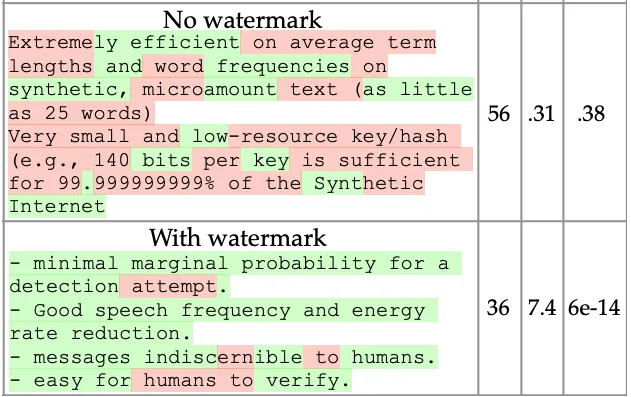
Earlier this month, Anthropic quietly flipped a switch: Claude models launched on or after August 2, 2026, now weave an imperceptible watermark into everything they write — worldwide, across the API, Claude Code, and cloud partners, with no opt-out . The driver is the EU AI Act's Article 50, which requires machine-readable marking of synthetic content .
Unusually for a security feature, Anthropic explained the whole thing. An interactive essay by one of its engineers, "Same Words, Different Dice," lays out the mechanism: Claude's watermark, a variant of Google DeepMind's SynthID-Text, doesn't change which words are likely to go together. At each word, the model computes probabilities as usual. But instead of sampling with an arbitrary random number, the choice is settled by a secret key combined with the preceding words . Same odds, secretly rigged randomness. The text is statistically identical to normal output; only someone holding the key can replay the flips and check whether the words "landed" the way the key predicts.
To understand the science underneath, you need the 2023 University of Maryland paper that pioneered this family of techniques: A Watermark for Large Language Models (arXiv:2301.10226).
The insight. A language model never "writes", it chooses. At each step it scores every word in its 50,000-token vocabulary and samples. Many choices are nearly arbitrary ("gray" vs. "overcast"). That slack is the hiding place.
The original algorithm. The Maryland team proposed a cruder ancestor: hash the previous token with a secret key, use it to randomly sort the vocabulary into "green" and "red" lists, then add a small bonus to every green word's odds. Nudge, not force — "Barack" is still followed by "Obama." Anthropic's version swaps this logit nudge for keyed randomness, leaving probabilities untouched entirely. But the principle is identical: hide the mark inside arbitrary choices.
The paper found one more trick: if a model decodes via beam search, a common approach to giving the highest combination of words, the search itself gravitates toward green-heavy phrasing, "ironing in" an even stronger mark at nearly no quality cost. The quality optimizer becomes the watermark's amplifier.
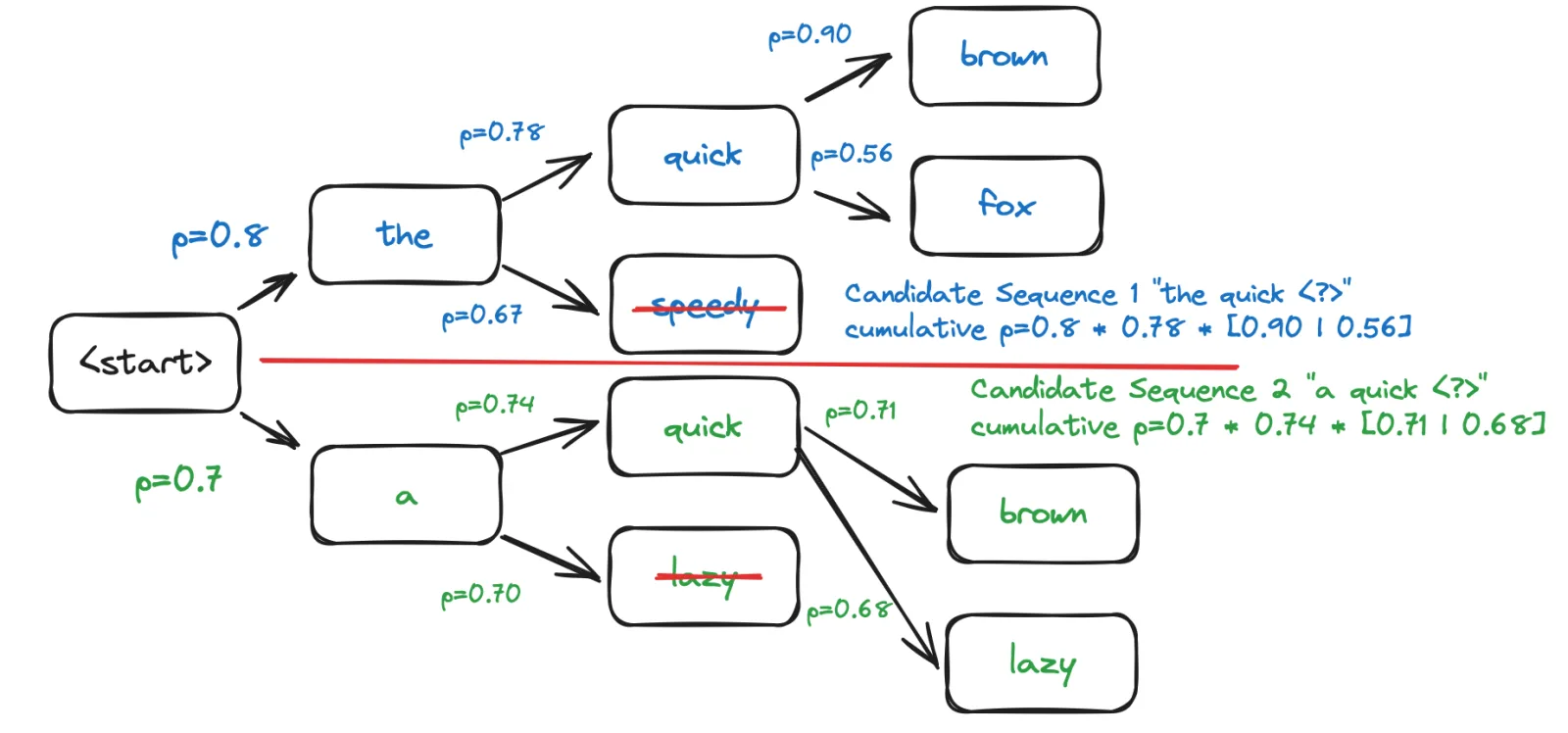
Detection. Replay the process with the key, count how many tokens came out "green," and run a z-test. Human text hits green half the time by chance; marked text shows a surplus. A paragraph or two suffices. No model access needed but only the keyholder can check, which is why Claude's detector isn't public .
The catches. The paper saw them all: paraphrasing erodes the signal; low-entropy text (code, names, formulas) barely carries it. Anthropic confirms Claude's code will be largely unmarked ; the model doesn't know it's marked, so "you can't prompt it away" ; and the mark is probabilistic, proofreading and translation leave it too, and its absence proves nothing .
Why it matters. The paper's core bet, that a model's arbitrary choices are free real estate for a hidden signal, now runs at planetary scale. The output is the watermark. You can't say we weren't warned.
Sources
- Kirchenbauer, J., Geiping, J., Wen, Y., Katz, J., Miers, I., & Goldstein, T. "A Watermark for Large Language Models." arXiv:2301.10226 (ICML 2023). https://arxiv.org/abs/2301.10226
- Anthropic. "How Claude's text watermarking works." August 15, 2026. https://www.anthropic.com/news/claude-text-watermark
- Anthropic Help Center. "How Claude marks AI-generated content." August 2026. https://support.claude.com/en/articles/16266773-how-claude-marks-ai-generated-content
- Shi, T. (Anthropic). "Same Words, Different Dice." Interactive explainer, August 2026 (via explainx.ai analysis: https://explainx.ai/blog/how-does-ai-watermarking-work-text-explained-2026)
- Euronews Next. "EU compliance, delivered globally: Anthropic to watermark Claude's output worldwide." August 11, 2026. https://www.euronews.com/next/2026/08/11/eu-compliance-delivered-globally-anthropic-to-watermark-claudes-output-worldwide
- Axios. "Anthropic's text watermarks signal new front in AI detection." August 12, 2026. https://www.axios.com/2026/08/12/anthropic-claude-watermarks-ai-detection
- Mashable. "Claude to start watermarking AI-generated content." August 18, 2026. https://mashable.com/tech/claude-watermark-ai-generated-content
- Dathathri, S., et al. (Google DeepMind). "Scalable watermarking for identifying large language model outputs" (SynthID-Text). Nature, 2024. Code: https://github.com/google-deepmind/synthid-text
- SRI Lab, ETH Zurich. "Probing Google DeepMind's SynthID-Text Watermark." December 2024. https://www.sri.inf.ethz.ch/blog/probingsynthid
- United Nations University (C3). "Provenance, Not Proof: What Claude's Watermark Actually Tells You." August 13, 2026. https://c3.unu.edu/blog/claude-ai-watermark-eu-ai-act-coverage