
Case study · Site selection
The seven-million-peso question
Choosing a retail site is a seven-figure bet, usually placed on instinct. Suds Premier was expanding fast enough that instinct alone could not keep up.
Allan Tan · Founder and Chief AI Scientist
Opening a laundry shop is not cheap. Fit-out, machines, deposit, the months of rent before anyone walks in. Upwards of ₱7 million before a single garment is cleaned.
That is the shape of the decision across most of retail. A seven-figure commitment, made two or three years before the evidence arrives, on a judgement call. The chains that get it right are not the ones with better luck. They are the ones with somebody who has learned to read a location, and that reading usually lives in one or two people’s heads.
Suds Premier has 63 branches and is still opening. At that rate the question stops being occasional and becomes operational: where does the next one go, and the one after that, and how does anyone answer at the speed the business is moving?
What does a good location look like?
Predictive Systems started where it starts on every project: not with a model, but with the question of what the system would be measured against.
There is no way to A/B test a branch opening. You cannot run the counterfactual, and by the time a site has proven itself either way you have spent the ₱7 million. What Suds did have was sixty-odd branches with years of trading history: a labelled dataset, if you were willing to treat it as one.
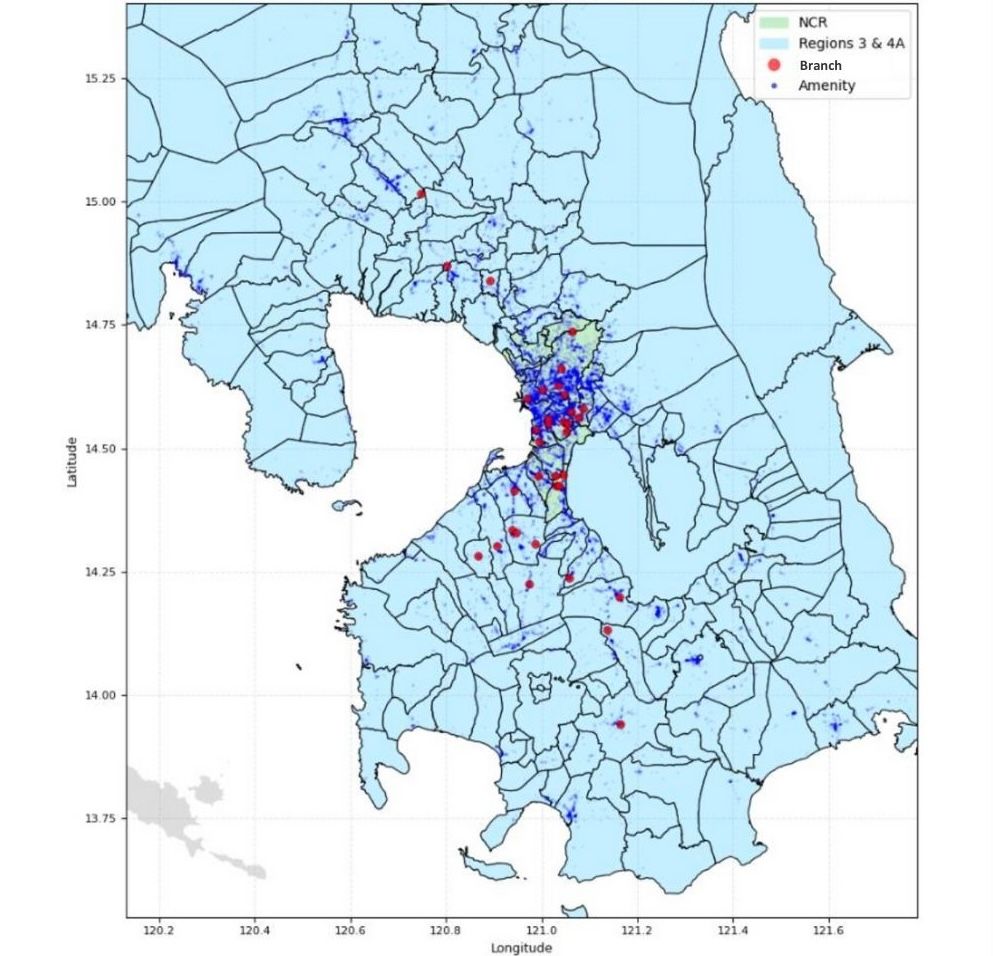
So the team mapped what surrounded the strongest stores. Not the stores themselves: the neighbourhoods. Using GIS data, they built a picture of the amenities within reach of every branch, then looked for what the best-performing locations had in common.
Open-source map data supplied most of it. Suds supplied the rest from its own records: floor area, parking, the physical facts of each shop that no public dataset carries.
Measuring who is actually there
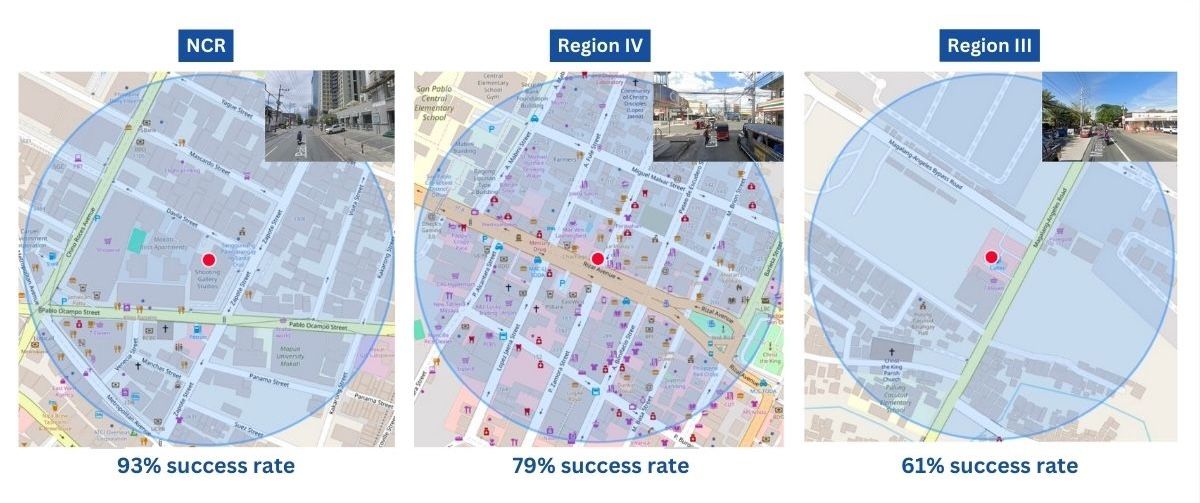
Population density turned out to be the strongest predictor, which is unsurprising. What was less obvious was how to measure it.
Census figures are coarse, out of date the moment they are published, and describe where people sleep rather than where they are. Condominium density is better. But the proxy that worked best was simpler and stranger: convenience stores.
A 7-Eleven is a bet somebody else has already placed. The chain has its own site-selection machinery, its own thresholds, and no interest in opening where the traffic will not support it. Where they cluster, people are, continuously and not just at night.
Borrowing another company’s completed analysis is not a sophisticated technique. On this dataset it was one of the most useful signals available.
The instinct was right. It was just slow.
The finding that mattered most to the engagement was not about the model.
The owner’s intuition is accurate, from decades of experience. But manually searching and checking is time consuming.
The system was not correcting bad judgement. It was correcting the cost of exercising good judgement: the days of driving, checking and eliminating that stand between an experienced operator and a shortlist worth looking at. Judgement of that quality does not scale by working harder. It scales by being handed a shorter list.
That reframed what was being built. Not an oracle that names the site, but a filter that removes the four sites in five not worth the drive, and gives the rest to the person who has been reading locations for thirty years.
The best locations were not available
The first version worked, and was useless.
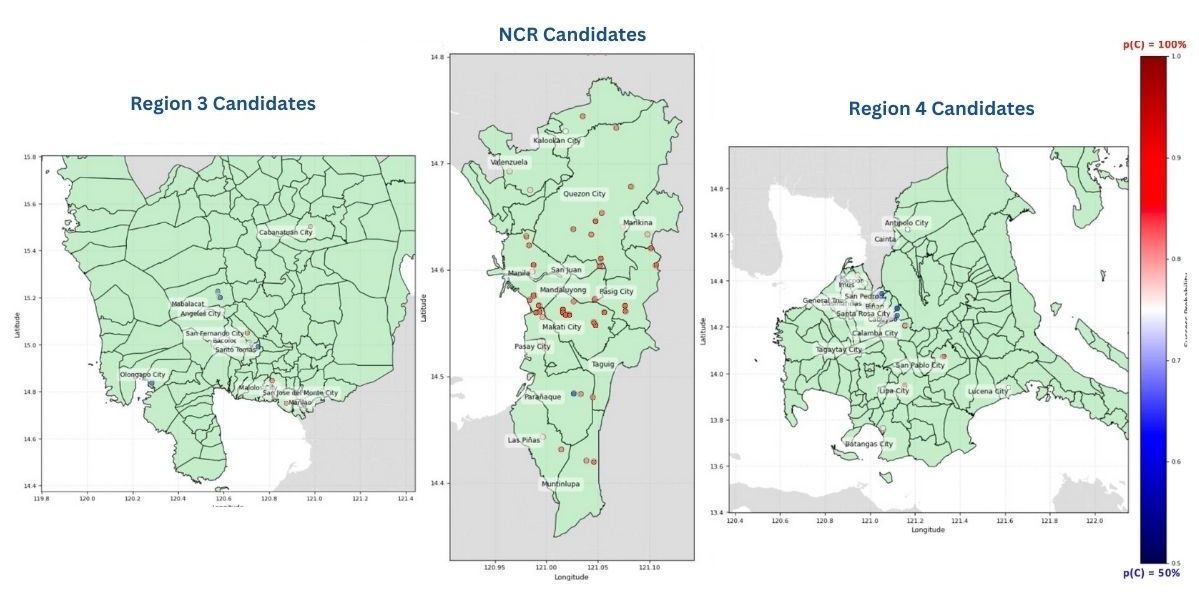
While we found the best locations, there was actually no available space.
It had been built to answer where should a branch go, and it answered well, identifying the strongest catchments in the metro. Several had no vacant commercial space at all. Others had space that would not come free for years.
The fix inverted the pipeline. Instead of ranking the map and then hunting for space, the system now starts from what is actually on the rental market and ranks only that. The question changed from where is best to which of these could we open, which is what the business had been asking all along.
It is the kind of error no amount of model evaluation would have caught. The model was accurate. The system was answering a question nobody could act on.
Three
Three branches have been opened using it. That is the whole number, and it will not grow quickly. At ₱7 million a site, nobody opens on a whim.
It is worth being plain about that rather than reaching for a bigger-sounding frame. The case for the system was never volume. It is that each individual decision carries a seven-figure commitment and a two-year wait to find out, and that a chain expanding this quickly has to make that call again and again. A tool that sharpens three of those decisions has already paid for itself, and the arithmetic does not need help.